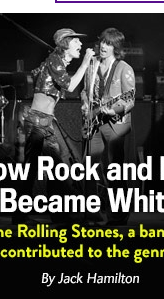
LINK: How Rock ‘n’ Roll Became White

screenshot-2016-10-06-11-47-38The rock writer Jack Hamilton is publishing a book called Just Around Midnight: Rock and Roll and the Racial Imagination. It’s an academic work, but a part of it is excerpted at Slate today and it’s well worth the slow start and long read.

Hamilton’s thesis is that the Stones were so adept at embracing and mirroring the black music they loved, that they eventually came to represent a new white authenticity that was embraced by white blues and metal bands that knew little or nothing about the Stones’ roots.

You can read the excerpt here.

I’m not sure what this means in the book’s larger picture, it is an excerpt of course, but without looking at the argument’s validity as regards the whole history of rock ‘n’ roll, this little slice of story feels kind of genuine. Like, yeah, that may be true, though he have maybe set up something of a straw man argument, too. Still feels like useful analysis.

But Hamilton draws in a lot of historical sources to tell this story, and it’s fascinating to read quotes in the black newspapers of 1964 praising the Stones, while the mainstream white press rips them down. And his description of the musical opening of Gimme Shelter is exact and thrilling, like the music itself.

It’s curious that the Margo Jefferson quote from earlier in the piece comes from 1973, which was also a germination point for Death, who we posted about here last week. It’s possible that this book will shed some light on the way rock ‘n’ roll evolved musically and as a business in a racial context.

Then, if you have time, Chuck Klosterman tries to figure out who the one figure from rock ‘n’ roll will be remembered 100 years from now, the way we think of marching band music as John Phillips Sousa and ragtime as Scott Joplin.

Film Review: Eight Days A Week: The Touring Years

Ron Howard is a master cinematic storyteller, for sure, but not someone with much interest in complexity or ambiguity. Which can be good for storytelling, but for me usually comes up wanting. I like the messy, the complicated, the things that make you say oh.

screenshot-2016-10-04-23-04-32I was curious about this picture, but would have let it slide, or ride, but friends invited me and my daughter wanted to go. So we went to Greenwich Village for some fine wood-fired brick oven Neapolitan pizza and Ron Howard’s joint, plus the promise of the whole Beatles at Shea Stadium film, remastered visually and auditorily using all the modern tricks.

The movie is a gas. The camera is up close on the Beatles and their fans through the 28 Days Later rush of Beatlemania, during the charge of concerts around the globe, and headlong up to the show at Shea Stadium. These guys, when they were young, ambitious and full of energy, were terrific cutups. And then it stays up close through the despair that followed the exhaustion that came after, when cutups transformed into turnoffs.

As I had expected, I felt as if I’d seen most of this footage before, but all of it was delightful, looked fantastic, and there are some revelations (for me anyway):

Early footage of some English shows in 1963 are fantastic and transforming. This wasn’t just a group of clever songwriters and melody makers, with winning personalities, but a hard rocking band. Ringo pounds on his kit, and the Beatles deliver with equal and transformative energy. Great songs, but also tight and terrific arrangements and wickedly and aggressively good playing.

McCartney, mostly, and Lennon, too, from old interviews, talk about their songwriting, and the need to hew to a schedule to put out a new single every three months, and an album every six months. The studio footage and tales, plus the clips from all the live shows they’re doing, and movies they’re making, really dial up the grueling nature of it all.

At one point Lennon talks about how silly the lyrics are in those early albums, really just placeholders while they worked on the music. Which seems like a throwaway, since so many are so clever and perfect to the form, until, later, he and McCartney talk about the personal content that John weaves into the lyrics of Help!, a song that to me has always seemed a novelty tied to the movie of the same name. But of course not!

I always forget what a cutup George was, even when I consider the hilarity of his film producing career. I mean, Withnail and I? This movie confirms he’s funny and serious, too.

I assume there will be a follow up, a sequel. Maybe Blue Jay Way: The Studio Years, but more likely Strawberry Fields Forever: The Studio Years, which will go further into the making of the last five elpees. That will no doubt be an equal treat. But the takeaway here is that the Beatles were really great, in a way that has no match, and we would be fools to forget about even a part of that greatness.

Ron Howard’s movie is a crowd pleaser, and lives up to that not modest ambition. Go and enjoy.

Death, “Where Do We Go From Here”

New to me. Detroit youths in 1971 decide to play rock rather than funk. Maybe they took some cues from the Stooges. They say Alice Cooper was a big influence. In 1975 Clive Davis funded recording sessions which yielded seven songs, but he insisted they change their name. They refused and he walked away.

In 1976 the band released a 45 with two songs in an edition of 500 copies.

Life was lived, and moved on. Fast forward 20 years, the children of members of Death form a band playing Death’s songs. They sign with Drag City and the record is finally released. The band reforms, though on original member has passed, and they record a new album and tour. A film is made about them.

Nice.

Song of the Week – Strawberry Letter 23, Brothers Johnson; Inspiration Information, Shuggie Otis

IGNORED OBSCURED RESTORED

One of the greatest albums you probably never heard is Inspiration Information by Shuggie Otis. If you’re a fan of Marvin Gaye’s What’s Going On and the great Stevie Wonder albums of the 70s (Music of My Mind, Talking Book, Innervisions, Fulfillingness’ First Finale, Songs in the Key of Life, whew!) you must listen to Inspiration Information. You will love it.

Shuggie is the son of R&B pioneer Johnny Otis who was sometimes called the Godfather of R&B because of his Zelig like appearances in the careers and recordings of most of the giants of the genre.

Shuggie is a multi-instrumentalist but is best known for his prowess on guitar. That led him to work with Al Kooper on Kooper Session (another album worth searching out) that was the follow up to the original Super Session with Stephen Stills and Mike Bloomfield, and Frank Zappa on Hot Rats as a 16 year old.

His second solo album – Freedom Flight (1971) – contained the great “Strawberry Flight 23” that was covered by the Brothers Johnson in 1977 and ran up the Billboard Hot 100 all the way to #5, #1 on the Soul charts.

Inspiration Information was released in 1974. Like Stevie Wonder of that era, Otis adopted a DIY ethic and played almost every instrument on the record himself. Musically, the album was a bit ahead of its time with the use of a Rhythm King analog drum machine. The overall effect is to station him as the missing link between Hendrix (or maybe Sly Stone) and Prince.

The title song was released as a single but only touched #56 on the R&B charts and never scared the pop charts. The album sales were poor too, so Epic dropped Otis who went dark for most of the next 40 years.

Enjoy… until next week.

Bob Dylan, “Mostly You Go Your Way (and I’ll Go Mine)”

Blonde on Blonde is so my favorite Dylan album, and it is one of those discs I have really been trying to tear apart lately, focusing on the instrumentation and production, particularly the rhythm section so I can think about how I approach playing the bass.

Dylan always had the killer side musicians for his recordings, which always seemed like fun experimentation in the evolution of the artist’s songs.

Al Kooper, Joe South, Robbie Robertson, and The Band–who at the time were still The Hawks–all played behind Dylan from Highway 61 and into Blonde on Blonde, so for the New York sessions of the album (Kenny Buttrey played for the Nashville sessions), Bobby Gregg took to the kit. Gregg had been a member of The Hawks during a time when Levon Helm was ex-expatriated from The Band.

Gregg is a killer, keeping time, popping his snare, and driving the whole affair and his work on the in your face Mostly You Go Your Way (and I’ll Go Mine) really shows just that. Not there are not other cuts on the disc that display that same elegant push within the pocket. This is just a lesser known cut.

It is really good, though. (BTW, this vid is a remix overseen by the great Mick Ronson).

Night Music: Meat Loaf, “Paradise by the Dashboard Light”

I confess to a strange and circuitous relationship with Meat Loaf’s Bat out of Hell album.

I did buy the album when it came out, and remember selling a friend–John Takauchi–the poster from within the album for $10, a hefty sum at the time. I do see the original album goes for $35 or so on Ebay, but did not see any posters that came with the initial pressing of the 1977 disc.

I did like the album, though I thought Jim Steinman’s songwriting a little overwrought and too angst-ridden, but Meat sings well, the band is great, and well, Todd Rundgren produced the whole thing and played guitar and those are good credentials.

The album came and went but suddenly I crossed paths with Meat who is a big Fantasy Baseball player, for we met a couple of times years ago when the National Fantasy Baseball Championship drafts were held in Las Vegas.

However, in 2011, after Diane and I had actually been together for a half-dozen years, Meat dropped in again.

I have to remind readers old and advise readers new, that my partner in life, Diane Walsh and I share very little musically. Over our 10 years together we have attended only one life concert together that did not involve either my band, or the band of a friends.

She likes the hit WTF and Dirty Deeds Done Dirt Cheap and Thrift Shop just to give an idea of the range of what she will listen to, but, as for liking bands or albums or things I like, we are on not just different planets: more like as I have written that music, for Diane, is something to listen to while at the gym.

Di and I have driven cross country a couple of times, and I mostly tried to mitigate the gap in our musical tastes by finding classic 80’s and 90’s, living on Boston and Georgia Satellites and their ilk while in the car.

But, during our second trip from Chicago to Berkeley we traveled Route 66, and during the end of May and we ran into some torrential rain just outside of Tulsa. The rain pelted us on the Interstate so hard that we had to pull over.

As we sat there, mesmerized by the crazy falling water, Paradise by the Dashboard Light came on the radio. Diane and I had never discussed this song (I might have mentioned that I met Meat) or album, but I started singing Meat’s part when the vocals came on, something not unusual for me. The cool thing was that right on cue, Diane began singing the Ellen Foley part, and we sat there, on the side of the freeway, pouring rain, singing the duet to and with one another about as spontaneously as permits.

It was quite fun, and one of those little magic moments in relationships, and as it is, a bunch of the songs from the album are on my shuffle for times when a cross pollination of our musical tastes is appropriate.

But, a week ago, as I was surfing for something to watch among the 300 derelict channels we get, the film Meat Loaf: In Search of Paradise was on and I found it pretty fun and interesting.

There was a clip of Paradise that is not the one below, but it does appear to be from the same tour. But, Meat and Karla DeVito (I believe) are great in the performance. And, overblown or melodramatic or whatever, the song and performance make pretty good theater.

Hmm. . .

The Keith Morris book tells me this is the first band Keith managed. I knew nothing about them, so I had to check it out. This is pretty damn good.

I love:

1) The Gibson/Marshall sound and the sound in general,

2) The little guitar riff that drives the entire song,

3) The Chuck Berry solo,

4) The drummer.

Drove me nuts for a while trying to squeeze who the singer sounds like out of my brain. It’s Leonard Graves Phillips from The Dickies.

I have a feeling I’m gonna be disappointed, but I need to do more investigating.

This is what pop/punk should be.