Pretty good, no? Kind of a darker take on the Talking Heads 77/Modern Lovers.
I learned about these guys, and a record company called Moonlee, that is dedicated to releasing new rock music from the former Yugoslav republics, from a Cuepoint survey of the scene.
The story ends with the story of Bernays Propaganda, a Croation band that is working these days sometimes with Mike Watt. Their tune Provekje is more indie than punk, but the story says their early stuff is angular, like Fugazi.
Another contemporary band, Serbian I think, is Replikator. This tune struggles to escape the murky bottom like that 90s mainstay Come.
What I didn’t know before today was that Brian Epstein, the Beatles manager, discovered these guys. He changed their name, and John Lennon suggested alternative spelling.
Plus their biggest hit was co-written by Paul Simon. He still gets royalties.
They played as an opener on many of the Beatles last stadium shows.
After the well ran dry they wrote jingles, and produced Foghat albums. Kind of crazy, like a red rubber ball with spin.
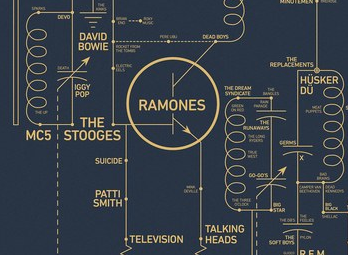
A design studio named Dorothy has released a survey of alt-rock music based on the schematic design of a transistor radio that came out in 1954, the year Bill Haley released Rock Around the Clock.
That’s a detail from a much larger image over to the left.
I’m not sure about the information included in the diagram. I mean why do the Ramones lead to Mink Deville lead to Talking Heads.
Why is Elvis Costello in smaller type than the Specials?
Why aren’t the White Stripes next to the Black Keys?
There are many of these questions, which seem to be answered rather randomly. That said, there is a broader logic as to time and place and style, and it’s good fun browsing using the magnification tool. h/t Herrick Goldman.
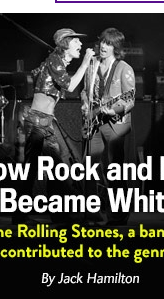
Hamilton’s thesis is that the Stones were so adept at embracing and mirroring the black music they loved, that they eventually came to represent a new white authenticity that was embraced by white blues and metal bands that knew little or nothing about the Stones’ roots.
I’m not sure what this means in the book’s larger picture, it is an excerpt of course, but without looking at the argument’s validity as regards the whole history of rock ‘n’ roll, this little slice of story feels kind of genuine. Like, yeah, that may be true, though he have maybe set up something of a straw man argument, too. Still feels like useful analysis.
But Hamilton draws in a lot of historical sources to tell this story, and it’s fascinating to read quotes in the black newspapers of 1964 praising the Stones, while the mainstream white press rips them down. And his description of the musical opening of Gimme Shelter is exact and thrilling, like the music itself.
It’s curious that the Margo Jefferson quote from earlier in the piece comes from 1973, which was also a germination point for Death, who we posted about here last week. It’s possible that this book will shed some light on the way rock ‘n’ roll evolved musically and as a business in a racial context.
New to me. Detroit youths in 1971 decide to play rock rather than funk. Maybe they took some cues from the Stooges. They say Alice Cooper was a big influence. In 1975 Clive Davis funded recording sessions which yielded seven songs, but he insisted they change their name. They refused and he walked away.
In 1976 the band released a 45 with two songs in an edition of 500 copies.
Life was lived, and moved on. Fast forward 20 years, the children of members of Death form a band playing Death’s songs. They sign with Drag City and the record is finally released. The band reforms, though on original member has passed, and they record a new album and tour. A film is made about them.
His parents were paid $200 when he modeled 25 years ago. The photography asked him if he’d take $200 again to celebrate the 25th anniversary and he said yes. Read about it here.
In anyMy Facebook friend Darren Viola posted this clip today of Boston’s Lyre’s playing somewhere haughty. My guess is Newport, but they rock as anyone would hope they would.
In any case, no matter what this is, it is a pretty sweet documentary look at people dancing. Go!
There was a time in the 70s, I think, when Bruce and Southside Johnny ruled. Maybe it was the early 80s. But around that time a band from Pittsburgh called the Iron City Houserockers emerged.
They were a real rock band with original songs, rock critics went crazy for them because of the blue collar origins and soul sound, but anyone who bought their albums (or singles, I guess) realized they were poor imitations.
I bought the second album, and I’m not proud, but what prompted this post was that I came upon a Sandanista! tribute album, on which the Houserockers cover Magnificent Seven. That says everything. (Not terrible, but not that useful either.)
There was a story in yesterday’s NY Times about Harley Flanagan, who has always been a presence in the NY rock scene. Most notably as the drummer bass player in the Cro-Mags, one of the most notable bands of the city’s hard core scene in the 80s. All age shows at CBGB in the afternoon were a fixture, and perhaps explain why I never really paid much attention. Too old! But this clip is terrific, reminds me of Penelope Spheeris’s fantastic movie, Suburbia, and it even better than that. You probably won’t want to listen to it all the time, but I hope you enjoy it first time through.


 Everybody who knows the Internet K-Hole says they love the Internet K-Hole. I’ve previously said it here and here.