What I didn’t know before today was that Brian Epstein, the Beatles manager, discovered these guys. He changed their name, and John Lennon suggested alternative spelling.
Plus their biggest hit was co-written by Paul Simon. He still gets royalties.
They played as an opener on many of the Beatles last stadium shows.
After the well ran dry they wrote jingles, and produced Foghat albums. Kind of crazy, like a red rubber ball with spin.
Van and Bob sitting on a hill with the Parthenon in the background, singing a Van Morrison song (that isn’t One Irish Rover) with acoustic guitar (Van) and harmonica (Bob).
Followed by One Irish Rover, both playing guitars, singing harmonies. Simple, but excellent nonetheless. With Van playing guitar quite nicely and hypnotically, kind of perfect. You probably don’t want less, and you certainly don’t want more.
There’s more after that, excellent Van, but the songs on the hillside are what got me here. Icons, maybe showing off, but simply.
My old friend Dot skipped the debate tonight to see ZZ Top in Scottsdale, in Arizona.
Good choice, I said, but then I started thinking about ZZ Tops’ biggest hit and the video that dominated MTV for a while and thought it provided some commentary for the current political situation, which involves a lot of lies, a discombobulated narrative, bullying and, we hope at the end of day, some women’s liberation. Even if we don’t ever see Hillary kiss Bill again.
As you might expect, the signifiers are a mixed bag. Just vote.
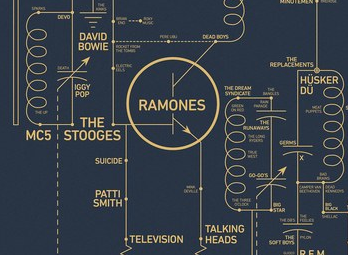
A design studio named Dorothy has released a survey of alt-rock music based on the schematic design of a transistor radio that came out in 1954, the year Bill Haley released Rock Around the Clock.
That’s a detail from a much larger image over to the left.
I’m not sure about the information included in the diagram. I mean why do the Ramones lead to Mink Deville lead to Talking Heads.
Why is Elvis Costello in smaller type than the Specials?
Why aren’t the White Stripes next to the Black Keys?
There are many of these questions, which seem to be answered rather randomly. That said, there is a broader logic as to time and place and style, and it’s good fun browsing using the magnification tool. h/t Herrick Goldman.
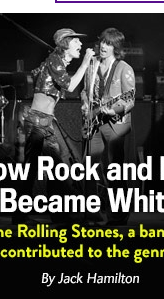
Hamilton’s thesis is that the Stones were so adept at embracing and mirroring the black music they loved, that they eventually came to represent a new white authenticity that was embraced by white blues and metal bands that knew little or nothing about the Stones’ roots.
I’m not sure what this means in the book’s larger picture, it is an excerpt of course, but without looking at the argument’s validity as regards the whole history of rock ‘n’ roll, this little slice of story feels kind of genuine. Like, yeah, that may be true, though he have maybe set up something of a straw man argument, too. Still feels like useful analysis.
But Hamilton draws in a lot of historical sources to tell this story, and it’s fascinating to read quotes in the black newspapers of 1964 praising the Stones, while the mainstream white press rips them down. And his description of the musical opening of Gimme Shelter is exact and thrilling, like the music itself.
It’s curious that the Margo Jefferson quote from earlier in the piece comes from 1973, which was also a germination point for Death, who we posted about here last week. It’s possible that this book will shed some light on the way rock ‘n’ roll evolved musically and as a business in a racial context.
Ron Howard is a master cinematic storyteller, for sure, but not someone with much interest in complexity or ambiguity. Which can be good for storytelling, but for me usually comes up wanting. I like the messy, the complicated, the things that make you say oh.
I was curious about this picture, but would have let it slide, or ride, but friends invited me and my daughter wanted to go. So we went to Greenwich Village for some fine wood-fired brick oven Neapolitan pizza and Ron Howard’s joint, plus the promise of the whole Beatles at Shea Stadium film, remastered visually and auditorily using all the modern tricks.
The movie is a gas. The camera is up close on the Beatles and their fans through the 28 Days Later rush of Beatlemania, during the charge of concerts around the globe, and headlong up to the show at Shea Stadium. These guys, when they were young, ambitious and full of energy, were terrific cutups. And then it stays up close through the despair that followed the exhaustion that came after, when cutups transformed into turnoffs.
As I had expected, I felt as if I’d seen most of this footage before, but all of it was delightful, looked fantastic, and there are some revelations (for me anyway):
Early footage of some English shows in 1963 are fantastic and transforming. This wasn’t just a group of clever songwriters and melody makers, with winning personalities, but a hard rocking band. Ringo pounds on his kit, and the Beatles deliver with equal and transformative energy. Great songs, but also tight and terrific arrangements and wickedly and aggressively good playing.
McCartney, mostly, and Lennon, too, from old interviews, talk about their songwriting, and the need to hew to a schedule to put out a new single every three months, and an album every six months. The studio footage and tales, plus the clips from all the live shows they’re doing, and movies they’re making, really dial up the grueling nature of it all.
At one point Lennon talks about how silly the lyrics are in those early albums, really just placeholders while they worked on the music. Which seems like a throwaway, since so many are so clever and perfect to the form, until, later, he and McCartney talk about the personal content that John weaves into the lyrics of Help!, a song that to me has always seemed a novelty tied to the movie of the same name. But of course not!
I always forget what a cutup George was, even when I consider the hilarity of his film producing career. I mean, Withnail and I? This movie confirms he’s funny and serious, too.
I assume there will be a follow up, a sequel. Maybe Blue Jay Way: The Studio Years, but more likely Strawberry Fields Forever: The Studio Years, which will go further into the making of the last five elpees. That will no doubt be an equal treat. But the takeaway here is that the Beatles were really great, in a way that has no match, and we would be fools to forget about even a part of that greatness.
Ron Howard’s movie is a crowd pleaser, and lives up to that not modest ambition. Go and enjoy.
New to me. Detroit youths in 1971 decide to play rock rather than funk. Maybe they took some cues from the Stooges. They say Alice Cooper was a big influence. In 1975 Clive Davis funded recording sessions which yielded seven songs, but he insisted they change their name. They refused and he walked away.
In 1976 the band released a 45 with two songs in an edition of 500 copies.
Life was lived, and moved on. Fast forward 20 years, the children of members of Death form a band playing Death’s songs. They sign with Drag City and the record is finally released. The band reforms, though on original member has passed, and they record a new album and tour. A film is made about them.
His parents were paid $200 when he modeled 25 years ago. The photography asked him if he’d take $200 again to celebrate the 25th anniversary and he said yes. Read about it here.