More (Mostly) Recent Rock Films

The Dave Marsh list from 1980 is a good one, but there have been a few notable movies with rock music since. This isn’t a best of, but a nod to some you may not have been aware of that are worth checking out.

Cocksucker Blues: Directed by the renowned Robert Frank (whose pictures grace the cover of Exiles on Main Street), the Rolling Stones did not approve the release of the film. For a long time the only way to see it was at a screening that Robert Frank attended (I first saw it in the 80s at Anthology Film Archives with Mr. Frank in the house). Now we have YouTube.

Ladies and Gentlemen, the Fabulous Stains: Directed by Lou Adler, Diane Lane’s first movie is a sordid and rocking look at girl-punky ambition running headfirst into the business and rock boys. Way overlooked movie.

The Runaways: In some ways the Fabulous Stains are built off of the Runaways, who many years later got their own Hollywood version. Not a great film, but great performances (especially Michael Shannon as Kim Fowley) and a good story with good music makes for a fine time.

Suburbia: Teen dystopia in Southern California, where the most fun is going to see TSOL. Directed by Penelope Spheeris, perhaps the greatest of our rock directors.

Decline of Western Civilization: Penelope Spheeris’s documentary look at the LA hardcore scene. Not available at this time.

Decline of Western Civilization: The Metal Years: Penelope Spheeris’s follow up, focusing on the LA metal scene of the ’80s. Not available at this time, either.

Pump Up the Volume: Christian Slater stars in this story of a new kid in town who becomes a secret hero dj operating his own pirate radio station. Directed by Alan Moyle.

Over the Edge: More suburban kids confront boredom and hypocrisy, starring Matt Dillon (maybe his debut) and directed by Jonathan Kaplan with a killer soundtrack that if nothing else will convince you how great a band Cheap Trick could be.

Sid and Nancy: Alex Cox’s biopic revels in the all the gooey awfulness of the Vicious-Spungen story, with great indelible acting.

Superstar: A movie telling the story of the Carpenters and Karen Carpenter’s bulimia, with all the characters played by Barbies. Todd Hayne’s film school thesis project could never be released because the Carpenter family refused to grant the rights. My wife got me a VHS copy back in the day from Haynes himself, but now we have YouTube.

Velvet Goldmine: Another Todd Haynes picture, this time a more traditional telling of a story of the glam life in the early 70s. Good fun, great music.

24 Hour Party People: It’s Manchester in the 1980s and a new kind of dance music is being invented by Tony Wilson at Factory Records.

Performance: Nicholas Roeg’s amazingly decadent portrait of a rocker in seclusion and the hit man who befriends him, or something like that. Starring Mick Jagger and James Fox.

Rude Boy: Not nearly as accomplished as the films listed above, it is notable because it stars the Clash but is the story of one of their roadies. Rough filmmaking, but a vivid punk work.

Best Rock and Roll Movies (circa 1980)

When I was a kid, the two non-sports books I had with me the most were the Rolling Stone Record Guide and Dave Marsh and Kevin Stein’s Book of Rock Lists.

In the chaos of my early college years, who knows what happened to it. But when my daughter Cara and I were perusing a used book store in Provincetown a couple of summers ago, there before me in the music section was that long-lost book. For $7, who could resist? That was less than the original cover price! I guess they figured no one would possibly want it.

I thought about it today when I read Steve’s post about his favorite rock documentary. Of course, “Best Rock and Roll Movies” was one of the lists. Here they are in order, with links to purchase if you so desire:

1.
King Creole (Elvis)

2.
(Sex Pistols)
3.
(Dylan)
4. The Beatles: A Hard Day’s Night

5.
(various including The Rolling Stones)


6. The Girl Can’t Help It
(Little Richard, Gene Vincent, Eddie Cochran and others)
7. (Jimmy Cliff)
8.
(Hendrix, Redding, The Who)

9.
(Paul Jones)
10.

Must-See Movie

My favorite rock doc is “It Might Get Loud” and, at the beginning of “Sound City” I thought it might be even better. It wasn’t, but it was still really, really good. I wish they would’ve focused more on the bands I like, rather than some I don’t like so much. However, I should feel lucky several of my very favorite bands are in it at all. And, if the whole movie was about those bands I like, no one would watch it, because no one likes the bands I like.

Later the movie gets into a lot of analog versus digital, which is interesting. If you want a compelling, digestible argument for analog, read the liner notes on The Hellacopters’ “Supershitty To The Max” (number three on my All-Time list). Yet another reason to buy it.

I rented “Sound City” via video on demand from my cable company, so it shouldn’t be very hard to find.

Bring on the Blinders

I’m trying something new. Whenever I find a band that I like, I don’t learn anything about them. I minimize my Pandora when I see “Northern Japan” in The Pillows bio. Lots of times Pandora has no biographical information at all and that’s even better.

I want the music. There are a rare few interesting music stories, or should I say variations on the same came from nowhere too much too soon death/disappearance and here they are with an abysmal comeback album yawn. I am sick unto dry heaves of the Legend of Keith Richards. I would be delighted to read about how Keith wrote “Connection,” or why they never finished “I’d Much Rather Be With The Boys,” or how those 378 great little touches on Stones’ songs came about. I don’t care where he shot up or how pharmaceutical his speedballs are.

So now I don’t wanna know and we’ll see how that works out. It’s not wholly possible for one thing. I already know that The Pillows are two guitar players, a drummer and a rotating guest bass player (just like Roxy Music!). I know that the Raveonettes are a guy and a girl. I like a band called Rogue Wave and I know that they are from California and have at least five members and that’s it. I’d like to keep it that way. I’m curious what y’all think of this band, they are softer than I usually like. Start with this:

Sorry, But I Couldn’t Resist

Tell me Tom Hanks doesn’t look exactly like John Benson these days:

The 67th Annual Tony Awards - Backstage & Audience

You Can’t Spell Remnants without R-E-M-A (uh-I)-N-S!

A nice story in the New York Times about a band most of us know from Nuggets. They broke up the week after opening for the Beatles at Shea Stadium in 1964, but they don’t really look back.

A Little Story Sure To Please Everyone

Earlier this year Dave Grohl revealed that Elton John would join his band Queens of the Stone Age on a song when the rock album hit stores later this year. Frontman Josh Homme had a chance to explain how that collaboration came about during a recent interview.

The scene Homme describes sounds straight from a movie. The classic rocker was riding in his car listening to Them Crooked Vultures (another Grohl side project) when his assistant recommended he turn to Queens of the Stone Age. “The guy driving the car was an old roommate of mine,” Homme told London’s XFM radio. “So all of a sudden, I get a phone call at my house on a Sunday. I picked it up and he said, ‘Hello Josh, this is Elton.’ I thought someone was messing with me.”

Elton John cut through any potential nervousness by quickly saying, “The only thing missing from your band is an actual queen.”

Jefferson Airplane: THE Best San Francisco Band

volunteers cov

I guess the news of ex-Jefferson Airplane/Hot Tuna drummer and percussionist Joey Covington’s passing earlier this week sort of pushed the thoughts I have always had about the Airplane into this virtual-osity.

I think of all the San Francisco bands–especially those who bore the “psychedelic” moniker–the Airplane were the truest to the spirit of rock ‘n’ roll.

True, The Dead were a great band,but they were a jam band. Big Brother was a great band, but they were a blues band. Quicksilver and Country Joe and the Fish were great bands, but they were indeed psychedelic,though the Fish gravitated more towards jug band music, and Quicksilver the blues.

However, though the Airplane could indeed be classified as a psychedelic band, they embraced what I think is the essence of real rock ‘n’ roll, and that is attitude.

It was the Airplane, who with White Rabbit encouraged us to “feed our head” as part of what I consider a favorite all time album of mine, Surrealistic Pillow.

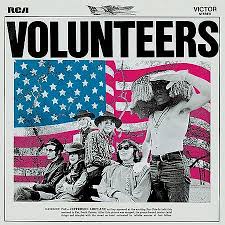
That disc followed Takes Off, which featured the band’s first drummer, Skip Spence, who then fled to Moby Grape (another great, albeit tragic band), and female lead singer, Signe Anderson. One the heels of Pillow came After Bathing at Baxter’s and then the wonderful Crown of Creation, but it was album #5, Volunteers, that really sealed the deal of the Airplane owning the the title of best band of their generation. That is because very few albums until then were as in your face as was Volunteers.

Aside from the faux salutes and homage/parodies to Old Glory all over the liner notes and inserts, the opening track , We Can Be Together, announced that as “outlaws in the eyes of America,” we would “cheat lie forge fuck hide and deal.” Equally menacing, the song then screams “Up against the wall, Up against the wall, motherfucker.”

The Farm implies the pastoral life romanticized by Flower Power is the way to go, and the beautiful pairing of the post-apocalyptic Wooden Ships (co-penned by David Crosby, Stephen Stills, and Paul Kanter) and Kantner’s adaptation of the lovely Good Shepherd, with the haunting guitar of Jorma Kaukonen might be demure compared to the fuck you of Together, but they never-the-less indicate there is a different path out there and we are on it, like it or not.

There is also the symmetry of the title track and closing cut, that screams “Look what’s happening out in the streets, got a revolution, got to revolution,” riffing off the Goodwill-like spiritual renewal organization Volunteers of America, shouting out just that: We are volunteers of America.

And, though spiritual renewal may indeed be what author Kantner was pointing to, it was certainly not a Salvation Army style one.

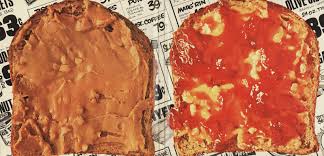
There are other parts of the album, like the half sides of a peanut butter and jelly sandwich–something so American–on either sides of the inside of the album, so that when closed, there was indeed a complete sandwich, albeit in just two dimensions.
pbj

Finally, there is the newsletter from the Paz Chin In, a Woodstock take off, that in the text gives us the lyrics (it was still the 60’s, so fuck is replaced by the word “fred”) plus cartoons, baseball stats (with a great subtle homage to local hero and SF Giant, Willie Mays), a goofy crossword puzzle with no questions but cryptic squares, and a funny reminder that says, “Neil Armstrong, first man on the moon.” However, the first is crossed out, and replaced with the word “last,’ and at the time it was true, that Armstrong was first and last.
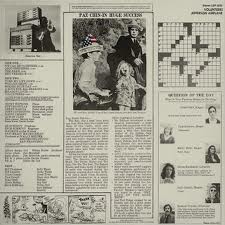
volunteers back

We are also reminded in the notes to “feed and water our flag,” among other suggestions

In my mind, there is no other statement by any band in the counter culture that ever embraced art and music and sentiments in such a fashion.  Within Volunteers, Jefferson Airplane pushed the agenda of “we are forces of chaos and anarchy,” sneering at the status quo while also supplying a deadly combination of cuts in here-to-fore uncharted territory.  In fact, nothing else was even close.

Of course the band did rankle in other ways. Like Grace Slick trying to get into the White House to then first daughter Tricia Nixon’s tea for Finch College graduates. Slick, as alumnae, was invited, and did try to attend. However, the singer was not allowed entrance. According to Slick, she and her date, Yippie Abbie Hoffman, were pulled out of the entrance line and denied because they were on the FBI watch list at the time.

Per Slick, all the Airplane were on the list for “suspect lyrics.” Also per Slick, she did try to sneak LSD in to slip Nixon the father–hardly beloved by the left at the time–a mickey (presumably in his cottage cheese and ketchup).

Jefferson Airplane did release a few more discs after Volunteers–Bark and Long John Silver–but they never had the bite of Volunteers. The band did release a terrific live disc, Bless it’s Pointed Little Head that captures everything that is Airplane, and features a brilliant cover of Fred Neil’s The Other Side of this Life, which opens with a Jack Cassady bass-line, that is then joined by some deadly interplay by Kaukonen, then Dryden, and the best of the band systematically joining in.

If the Airplane peaked with Volunteers, they then slowly landed, re-emerging as Jefferson Starship, which was a Kantner/Slick/Balin endeavor to start, but quickly the principles abandoned ship, and the group morphed into the Starship, which really had nothing to do with anything Jefferson at all.

However, Kaukonen, Cassady, and the late Covington did form their own spin-off, Hot Tuna who did stay true to the folk-blues roots that signaled a lot of the original band’s sound in the first place.

Certainly, the Airplane, and especially the then exotic and brainy Slick, with the powerful voice, generated a lot of buzz when they entered the eye of the public at large, but to me at the time it all seemed in the context of the media trying to be or act hip. And, though Slick was indeed a great character, the real story was what a killer band the Airplane really was.

More to the point, they were a great band that embraced the “fuck all of you in the mainstream” principles that are the essence of rock ‘n’  roll.

What Goes Around…

For Phil Lynott, who is playing bass (with Steve Jones and Paul Cook too)

Bang Bang. Maxwell’s Is Nearly Dead.

Hoboken Maxwell's NJThere are bars with music and there are legendary bars with music. Maxwell’s, in Hoboken NJ, will be one of the legendary ones for just another two months. I lived in Hoboken in 1981, when Maxwell’s, just three years old, wasn’t yet venerated. At that time it was too new and too exciting, regularly booking the same bands that were playing CBGB, across the river, and serving as something of a home club for Yo La Tengo and the Feelies, among others. During my Hoboken days I remember going to see bands at Maxwell’s, drinking beer at Maxwell’s, having brunch at Maxwell’s, but I don’t remember at this point what bands I saw at that point. At that point the point wasn’t the names, but the music, which was still lively and energized by punk, hugely broadly do it yourself, full of folks making their own legends (and sometimes succeeding) making rock or what became known as Alt-Country, in a movement that changed the tastes of the nation.

The first show that I remember going to see at Maxwell’s by design involved commuting across the Hudson River via the PATH train to see the legendary British punk band the Mekons, whose amazing country record (and that does not do it justice) was called Fear and Whiskey in the UK and had just been released in the US (with some extra tracks) as Original Sin. The room with the music at Maxwells was small then (and is still the same small), an irregular box with a myriad of obtuse and acute angles on the perimeter, plus columns in the middle, kind of the shape of a game controller, only you’re on the inside. There were some chairs and boxes for sitting around the edges, a bar in the back, and the band was crammed into a nook at the other end of this rhomboid box, crushed amidst whatever speakers and amplifiers were stacked up there to help them make noise. The Mekons that night had at least seven people jammed on the stage, and it seemed like 20, playing the usual guitar, bass and drums, with Sally Timms on vocals, and also a fiddle player and an accordion player and a few others who banged on things this and that and who sang along, too, at the sing-songy parts.

mekons liveThe room was packed with expectation on June 20, 1986. The Mekons had always been a political band, but arch, funny, engaged, enraged, also aware they they were playing music ferchrissakes. Their first single, released at the height of punk mania, was called “Never Been in a Riot.” Unlike the Clash.

Their music in 1977 was brittle, angular, clangy, totally amateur. They couldn’t play. A legend arose that if you learned to play your instrument the Mekons kicked you out. The Mekons were masters of the ethos of the naif, the beginner, but over the years their chops improved and their ambitions grew. Jon Langford developed as a guitarist and songwriter. He fell in love with Hank Williams and he steered the band toward the fabulous hybrid they developed in Fear and Whiskey. It’s country, but not afraid of reggae and afropop, in places, homespun but raging with anger about the injustices of the Reagan/Thatcher years and the darkness at the heart of the soul. And that isn’t the half of it. Love songs, sex songs, passion, history, politics, metaphor, but most of all joyous strange music that often sounded trad., music from the ages, but was played by a big rock ensemble with passion and craft. It was was wholly original, like nothing exactly you’ve ever heard before, but full of the spirit that courses through your soul, maybe like marrow. At least on your good days.

This was quite suddenly a band at the top of their game, at the top of anyone’s game, Fear and Whiskey representing the first of a string of maybe five albums (Fear and Whiskey, The Edge of the World, The Mekons Honky Tonkin’, So Good It Hurts, Rock and Roll) that are as first rate as any such sequence in rock history. This was a band for whom the motives seemed to be purely moral, large of heart, full of sensual pleasures that come from making great rocking music with your friends. That sweaty woozy hot night at Maxwell’s I had the unalloyed joy of being in a packed room full of people who were becoming members of the band that was up on stage, the audience pushing them hard, the band embracing their fans and embracing the push, and making music back at us! Encouraging us! By the end we felt like we’d been invited onto the tour bus for the rest of our lives, and while we get off here and there, the many times I’ve seen the Mekons live since, as soon as the band comes on stage, it’s like you’ve never really been away. We’re all serious friends, here to laugh and to grouse together. Together.

Maxwell’s owner announced this week that the club was closing. In this obit in the New York Times owner, Todd Abrahmson, said that they could probably make the business work for another year or two, but that the changes in Hoboken’s demographics make the club’s demise inevitable. “If you think of Willie Mays playing outfield for the New York Mets — I didn’t want us to wind up like that,” he said.

Abrahamson now books the Bell House in Brooklyn, which happens to be on my street, a few blocks down the hill in Park Slope, and where I saw the Mekons play last year. Somewhere I have a file with a recording of that show, but what I was really excited to find was a recording of that show at Maxwell’s back in 1986 at archive.org. Not like being there, but a swell souvenir and not a waste of your time.