John Sebastian wrote “Darling Be Home Soon” for the soundtrack to Francis Ford Coppola’s 1966 film You’re a Big Boy Now, while still with The Lovin’ Spoonful.
“Darling…” is very sentimental which is typical of so many other Sebastian compositions. It was one of five songs Sebastian played at his unscheduled performance at Woodstock.
The Lovin’ Spoonful version is terrific but Joe Cocker did it one better. He ditched the sappy strings for a more organic musical arrangement (including a great piano part) and gave it a gospel feel, all without losing the earnest sentiment of the original.
The lyric is a love letter to a dear one that is away and sorely missed. This has got to be the only song in rock history that would attempt a rhyme like “dawdled” and “toddled.” A bit twee, but perfect for the emotion of the song.
The melodic structure of the composition is flexible enough to have a different form in each of the verses. For instance, in the first verse the last two lines end in rhymes. In the second verse the last three lines rhyme. In the final, shortened verse, there is no rhyme for the final line.
Although I chose to present the Cocker version to you, check out the Lovin’ Spoonful original too.
Someone recently posted a list of Tom Petty’s favorite songs as enumerated in an appendix to his biography. I checked it out and was surprised by one of his selections – “I Can Help” by Billy Swan. Just last week he included the song in the playlist for his SiriusXM radio show, Buried Treasures. Clearly he’s fond of this song.
For me, the 1974 hit is a reminder of my high school days, driving around town, listening to AM radio, which is pretty much all most cars had back then.
It’s a slight song, both lyrically and musically, but it’s also very catchy — especially its use of those distinctive, alternating Farfisa organ chords over the rockabilly shuffle. Many articles claim the organ Swan used was a wedding gift to him from Kris Kristofferson and (then wife) Rita Coolidge. But in a 2007 article I found, Swan told interviewer Richard Buskin that the gift organ was used to write the song and produce a demo, but was not the one he used on the commercially released recording.
Although “I Can Help” was Swan’s only hit as a performer, he had earlier success in the music business. He wrote “Lover Please” that was a top 10 recording in 1962 for Clyde McPhatter, who had left the Drifters in 1954 after serving a stint in the Army.
As a producer, he hit in 1969 with Tony Joe White’s Southern cult classic “Polk Salad Annie.” As an instrumentalist, he was a touring musician in bands for Kristofferson, Kinky Friedman and Billy Joe Shaver.
Swan says he wrote “I Can Help” in just 20 minutes. More than 40 years later, that 20 minutes of inspiration is still satisfying listeners.
One of my favorite bands of the 80s and 90s was Australia’s Crowded House, the band founded in 1984 by Neil Finn. If you’ve never heard Woodface (1991) in its entirety, check it out. It is a flawless record.
So naturally, I’ve also been interested in the earlier music Finn made with his brother Tim in New Zealand’s Split Enz. That band started in the late 70s and managed to release about nine albums before calling it quits. The most successful was True Colors (1980) that contained their biggest hit – today’s SotW – “I Got You.”
Initially the band thought “Shark Attack” was the album’s most likely hit, so they made it the lead track, followed by “I Got You.” But when “I Got You” took off, they repressed the record with the order of the two songs reversed.
The production of the song is very much of its time (early 80s) but it has a memorable, singable chorus that is timeless.
I don’t know why sometimes I get frightened
You can see my eyes, you can tell that I’m not lyin’
I don’t know why sometimes I get frightened
You can see my eyes, you can tell me you’re not cryin’
They album made other breakthroughs as well. It may have been the first vinyl pressing to be laser etched. Very cool and collectible.
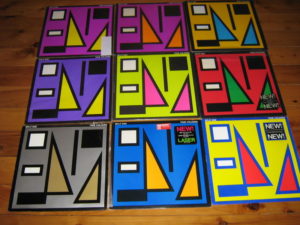
The cover was also released with a single graphic design but in nine different color combinations — yellow and blue, red and green, purple and yellow, blue and orange, yellow and red, lime green and pink, hot purple and burnt orange, and gold and platinum.
The Red Button is an LA based power pop duo of Seth Swirsky and Mike Ruekberg. So far, they’ve only released two albums – She’s About to Cross My Mind (2007) and As Far As Yesterday Goes (2011). Even though both have received wide acclaim in power pop circles, you still probably never heard of them.
I know about them because I’m a regular listener to Little Steve’s Underground Garage on SiriusXM. That channel plays a song off the first album called “Cruel Girl” that is today’s SotW.
In 2007, the Underground Garage chose it as one of their weekly “coolest songs in the world.”
“Cruel Girl” has an authentic 60s garage pop sound — retro chiming guitars, harmony vocals and an instantly catchy melody. It could be a missing song from the catalog of The Beatles, Beau Brummels or maybe Badfinger. It’s anyone’s guess. The video for the song captures the era beautifully – all things British, teeming with miniskirts and go-go boots.
According to their official website, Swirsky has been a successful songwriter for other artists (“Instant Pleasure” for Rufus Wainwright, “Love is a Beautiful Thing” for Al Green and the Grammy nominated “Tell it to My Heart” for Taylor Dayne) while Ruekberg composed the soundtrack for the cult classic Dummy.
On a side note, Swirsky is also a baseball fan, writer and memorabilia collector. He owns the infamous ball that slipped through Bill Buckner’s legs and caused almost 20 more years of pain for Red Sox fans (myself included) and the last know bottle of bubbly that the error left unopened that season.
The Tragically Hip is a band that is yuuuge in Canada but not so well known below the border, here in the US (except for a few spots like upstate New York). There are other acts in that category — Sloan comes to mind – but none as well loved as The Hip. They write and perform their own brand of hard rock anthems.
I recently stumbled across an article in the New Yorker that covered the band’s farewell tour (New Yorker – Canada’s Biggest Rock Band Say a Dramatic Goodbye). Apparently the band’s lead singer, Gord Downie, has a particularly nasty, terminal brain tumor known medically as glioblastoma.
Hearing about this prompted me to write this long overdue post on my favorite song by The Hip, “Fifty Mission Cap.”
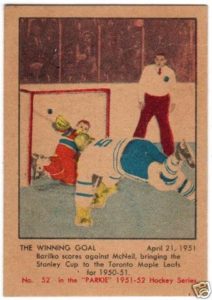
This song rocks! But one of the reasons I’ve always liked it so much is because it has such an interesting back story. It all starts with a card.
The verse tells the story of Bill Barilko, the hockey player that scored the winning goal to give the Toronto Maple Leafs the Stanley Cup in 1951. A few months later, Barilko was on his way to a fishing trip when his private plane crashed and he went missing. Some Leafs fans felt this set off a curse. Some believed they couldn’t win another Cup until his body was found. Others said his body wouldn’t be found until they won another Cup.
In April 1962 the Leafs won their next Stanley Cup. About 2 months later Barilko’s remains were finally discovered about 60 miles from the place his plane was thought to have crashed.
So what has any of this got to do with a “fifty mission cap?”
I found the answer to that at a fan website called The Hip Museum, dedicated to “the people, places and poetry found in the music of The Tragically Hip. You will find listed here all of the references that make The Hip’s music so entertaining and enriching.”
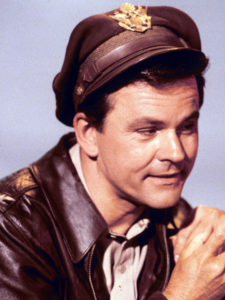
HOGAN’S HEROES Bob Crane as Colonel Robert E. Hogan
It turns out Gord wanted to make the story a little more interesting so he melded it with the legend of the WWII fifty mission cap. Pilots in the war were issued caps that they wore under headphones when flying bombing missions. Over the course of 50 missions (if you were lucky enough to survive that many) the caps would become crushed. This was such a status symbol that pilots would intentionally break them in to achieve “the look.” I’ll let The Hip Museum take it from here, quoting Cory Graff of the Seattle Museum of Flight:
“But here’s the little detail that might be important to part of the song… It was cool to have the sides of your hat all smashed. But it was very uncool to have the front droop down or collapse. As a result, many of these guys put in a piece of cardboard or a playing card on the inside in the front to keep it all going upward. So this hockey card (doing a bit of time travel I guess) is worked into the front of the 50 mission cap as a stiffener.”
BTW, if you’re wondering, a fifty mission cap looks like the one Colonel Hogan (Bob Crane) wore in Hogan’s Heroes.
I hope this post turns a few more Americans onto one of Canada’s best kept secrets.
The earliest rock and roll music dealt with a few recurring subjects – cars, fashion, school… and GIRLS!
There are a million rock songs about girls. Many call girls out by name – Gloria, Peggy Sue, etc.
Some pay homage to their geographical location.
California Girls – The Beach Boys
Italian Girls – Rod Stewart
Southern Girls – Cheap Trick
West End Girls – Pet Shop Boys
Others deal with their emotions.
Big Girls Don’t Cry – Four Seasons
Girls Just Want to Have Fun – Cyndi Lauper
Girls Talk – Elvis Costello/Dave Edmunds
Today’s post is a tribute to a few of my favorite rockers about GIRLS.
I’ll start with “Oh Girls, Girls” by a Texas based garage band called The Sparkles.
This hep number was released in 1966 as the b-side to “The Hip.” The vocal is awesome. The urgency borders on lecherous.
Next is Iggy Pop’s “Girls” from 1979’s New Values.
The proto punk is in form for this release which came at the peak of the punk/new wave return to the straight ahead rock ‘n roll style he pioneered with the Stooges in the late 60s.
Another punk pioneer was David Johansen, originally of the New York Dolls. He released his song about “Girls” on his self-titled solo debut in 1978.
This is another party rocker. Like all of the others, the lyrics are just an unabashed ode to a guy’s infatuation for girls of all types.
By the mid-80s, Hip Hop had worked its way into mainstream pop culture. The Beastie Boys added their “Girls” to the ongoing history of the genre.
This is typical of the Beasties goofy, humorous take on any subject they tackle.
I apologize if any of these songs come across as sexist or politically incorrect. But it’s only rock and roll and I like it.
Back in the early 80s I was a fan of Uncle Tupelo – the brainchild of Jeff Tweedy and Jay Farrar. When they split to form new bands – Tweedy with Wilco and Farrar with Son Volt – I was going to follow both.
Since then, Tweedy has come out on top. Wilco has been a hugely successful, critically acclaimed band and Tweedy has had further success as a producer and collaborator.
Wilco started covering the same alt-country terrain that was staked out by Uncle Tupelo. They would eventually record the adventurous Yankee Hotel Foxtrot and other innovative albums. The bridge between was Summerteeth (1991).
On Summerteeth, the band changed their recording style from “live in the studio” to more heavy reliance on overdubs and post production. Today’s SotW is “Can’t Stand It”, the lead off track from Summerteeth.
In fact, “Can’t Stand It” was originally recorded in a simpler form. But the record company suits at Reprise intervened and persuaded the band that it needed to be remixed to make it a more suitable single for a broader radio audience. I’ve never heard the original (I can’t believe it wasn’t included in the “expanded” reissue of Summerteeth along with the other bonus cuts) but I’ve read that they shortened the bridge and added bells. (Other than Naked Eyes version of “Always Something There To Remind Me”, who puts bells on a rock song?)
The lyrics tell the age old story of a broken relationship. This time it seems to center on the lies or misunderstandings between the couple.
The way things go
You get so low
Struggle to find your skin
Hey ho
Look out below
Your prayers will never be answered again
Phones still ring
And singers sing
Speakers are speaking in code
What now
Well anyhow
Our prayers will never be answered again
Depending on when you became aware of Wilco might affect how well you like this song. Fans of the later albums might find this too poppy. But I think the song has soul and the spirituality of the line “prayers will never be answered again.”
I’ve always found the history of the Fine Young Cannibals to be very strange and confusing – at least the ending.
The band came together in 1984 when The English Beat (“Mirror in the Bathroom”, “I Confess”) broke up and two of its members, Andy Cox (guitar) and David Steele (bass) struck out on their own to form a new band. They auditioned hundreds of singers before they found the unique voice of Roland Gift.
A year later they released their first album which contained a clever reworking of Elvis Presley’s “Suspicious Minds” and their own “Johnny Come Home” which is today’s SotW.
That album and those songs were big hits around most of the world but received little attention in the US other than on alternative rock radio.
It took the band another 3 years to release their second album, The Raw and the Cooked (1989). All they had to show for the time between was a bunch of songs they recorded for the soundtracks to the films Tin Men and Something Wild, a few of which later ended up on The Raw and the Cooked.
That album was huuuuge! It reached #1 in the US, UK and Australia and spawned #1 singles hits with “She Drives Me Crazy and “Good Thing.” (I remember spinning both continuously when I was a club DJ in Boston.)
But this is where the story goes off the rails. The band never recorded a follow up. How could that happen? Was there tension among the band members? Did someone become ill? Were they trying to get out of a bad recording contract? The answer to all of these questions is no.
In a 2014 interview with the Sunday Express, Gift explained:
“I fully expected the band to carry on and make a few more albums, but to be honest, I’m not sure what happened. We just stopped functioning as a band. It was sad, really. There was a lot of pressure from people around us to sell more and more records, but music doesn’t work like that. It has to evolve naturally.”
That’s not a very satisfying explanation but it’s all we have. Too bad, because the band showed so much promise especially on the first disc. Now they’re little more than a footnote in the rock history of the 80s.
In a couple of weeks I’ll be going with a friend to see Jeff Beck and Buddy Guy. It should be a fun evening of rock and blues.
Guitar hero Jeff Beck has been the focus of the media recently, touting his new album Loud Hailer. This is the first release in six years from the 72 year old axe man and it has received pretty good notices,mostly applauding the modern sound he captures by working with the young women of London based Bones — vocalist Rosie Bones and guitarist Carmen Vandenberg.
The first SotW is “Live in the Dark” from Loud Hailer.
Many of the songs on Loud Hailer have political themes, but not “Live in the Dark.” This is just a simple sample of modern garage rock.
Although I’m digging the new release, I still relish going back to his first solo album, Truth, for great blues based rock. His band for that album had Rod Stewart on vocals and Ronnie Wood on bass with a little help from friend Nicky Hopkins (piano) on a few cuts.
The next SotW is “Blues Deluxe” from that album.
The song sounds like a live recording but I’m not sure if it really is live or just overdubbed with audience applause to make it appear that way. I can’t understand why they would do that but it doesn’t really matter.
In a 1973 article by Charles Shaar Murray in New Musical Express, he writes of “Blues Deluxe”:
“After Rod and Nicky have slugged out several identical choruses, Beck comes in for his solo, stopping the entire band to play a totally extraneous riff, and then producing assorted gabbles and screeches, finally divebombing into a minor conflagration at the bottom of the neck before leading it back into the next verse.”
Beck has always demonstrated flamboyance and independence in his playing!
True to the folk/blues tradition, Beck/Stewart avail themselves of a bit of “borrowing” for this number. It is a reworking of B.B. King’s “Gambler’s Blues.” Check it out sometime.
A few years ago a film was released called 20 Feet from Stardom (2013). It’s all about the background singers whose fine work has supported so many more famous acts in the studio and on the road.
Today’s post highlights a few of my favorite examples of the value the background singers often contribute.
Merry Clayton, perhaps the most sought background singer in the rock era and one of the featured artists in 20 Feet from Stardom, provided the memorable performance on the Rolling Stones’ “Gimme Shelter” (1969).
In a 2013 interview on Fresh Air with NPR’s Terry Gross, Clayton told her story about the making of “Gimme Shelter.”
Well, I’m at home at about 12–I’d say about 11:30, almost 12 o’clock at night. And I’m hunkered down in my bed with my husband, very pregnant, and we got a call from a dear friend of mine and producer named Jack Nitzsche. Jack Nitzsche called and said “You know, Merry, are you busy?” I said “No, I’m in bed.” He says, “Well, you know, there are some guys in town from England and they need someone to come and sing a duet with them, but I can’t get anybody to do it. Could you come?” He said “I really think this would be something good for you.”
Mick Jagger told NPRs’ Melissa Block on All Things Considered:
“We randomly phoned up this poor lady in the middle of the night, and she arrived in her curlers and proceeded to do that in one or two takes, which is pretty amazing. She came in and knocked off this rather odd lyric. It’s not the sort of lyric you give anyone–‘Rape, murder/It’s just a shot away’– but she really got into it, as you can hear on the record.”
Clayton later lost her pregnancy to a miscarriage. Though unrelated, the association with “Gimme Shelter” made it very difficult to listen to the song for many years.
In 1970 Led Zeppelin released their acclaimed 4th album. “Stairway to Heaven” get the most attention but deep cut “The Battle of Evermore” is equally worthy. And it wouldn’t be the same without the vocal provided by Sandy Denny.
The song has the flavor of a traditional British folk song, so inviting Sandy Denny – whose pedigree was with Fairport Convention and Fotheringay – was a natural choice. Robert Plant and Denny perform a duet on this song. It is a story that references The Lord of the Rings where Plant plays the role of the narrator and Denny represents the town crier. “… Evermore” is the only Led Zeppelin song that has ever used a guest vocalist. Well played!
Maggie Bell’s effort on Rod Stewart’s “Every Picture Tells a Story” is smaller but no less significant.
She adds harmony on the fabulous fifth verse and, along with John Baldry, sings the “every picture tells a story, don’t it” line that repeats through the end of the song. But her best part is when Stewart sings the line “Shanghai Lil never used the pill” and Bell spits out the response “she claimed that it just ain’t natural.” That seals the deal for me.
Lastly is Clare Torry’s improvised vocal on Pink Floyd’s “The Great Gig in the Sky.”
Torry was introduced to the band by Alan Parsons, who engineered the classic Dark Side of the Moon at Abbey Road. Initially reluctant, Torry agreed to the session and recorded 2 ½ takes. The final was an edit of all three takes. All pressings of the song since 2005 give Torry co-writing credit for “TGGitS.”
I can’t imagine any of these iconic rock records without the key contributions from these female supporting vocalists.


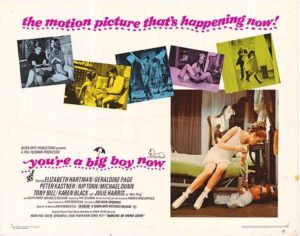 John Sebastian wrote “Darling Be Home Soon” for the soundtrack to Francis Ford Coppola’s 1966 film You’re a Big Boy Now, while still with The Lovin’ Spoonful.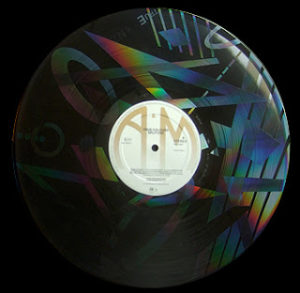
 IGNORED OBSCURED RESTORED