Song of the Week – Kodachrome, Paul Simon; Us and Them, Pink Floyd; Stir It Up, The Wailers

Congratulations to the New York Knickerbockers for winning the 2026 NBA Championship.  Much has been made of the Knicks’ 53-year title drought.  Their last championship came on May 10, 1973, when they defeated the Los Angeles Lakers four games to one, winning four straight after dropping the opening game in Los Angeles.

To appreciate just how much time passed between championships, let’s take a trip in the Way-Back Machine and revisit some of the terrific music we were listening to in the spring of 1973.

A logical place to start is There Goes Rhymin’ Simon, since Paul Simon is the quintessential New Yorker — even if he’s more of a Yankees fan than a Knicks fan. Released on May 5, 1973, the album earned a five-star rating in the first Rolling Stone Record Guide and was nominated for Album of the Year at the 1974 Grammy Awards.

The album opens with “Kodachrome,” which was released as a single and climbed to No. 2 on the Billboard Hot 100.

More than fifty years later, “Kodachrome” remains one of the great summer songs, buoyed by an infectious melody, sunny harmonies, and a soaring chorus:

Kodachrome
They give us those nice bright colors
Give us the greens of summers
Makes you think all the world’s a sunny day, oh yeah
I got a Nikon camera
I love to take a photograph
So mama, don’t take my Kodachrome away

If Paul Simon provided the soundtrack for a sunny afternoon, Pink Floyd supplied the soundtrack for late-night contemplation.  The Dark Side of the Moon was released on March 1, 1973, and has since become one of the most successful albums in history.  It has sold more than 45 million copies worldwide and spent an astonishing 996 weeks on the Billboard album chart.  Like There Goes Rhymin’ Simon, it earned a five-star rating in the first Rolling Stone Record Guide and was later included in MOJO’s The Greatest Albums of All Time.

While “Money” remains the album’s signature hit, I’m choosing “Us and Them” for today’s post.  Perhaps that’s my saxophone player bias. 

Originally composed by Richard Wright for Michelangelo Antonioni’s film Zabriskie Point, the music was ultimately rejected for the soundtrack.  Repurposed for The Dark Side of the Moon, it became one of the album’s emotional centerpieces, pairing Wright’s haunting melody with Roger Waters’ meditation on conflict, division, and human indifference.

Another landmark release from the spring of 1973 was Catch a Fire, issued by The Wailers on April 13.  Like Dark Side of the Moon, it earned a place in MOJO’s The Greatest Albums of All Time.  For many rock fans, Catch a Fire served as an introduction to reggae music, bringing the sounds of Jamaica to a much wider audience.

The album was memorable even before listeners dropped the needle.  Early pressings came packaged in an ingenious album-sized Zippo lighter sleeve, complete with a hinged top.  It was an expensive production choice, but one that perfectly matched the music’s originality. (I still have one in my collection.)
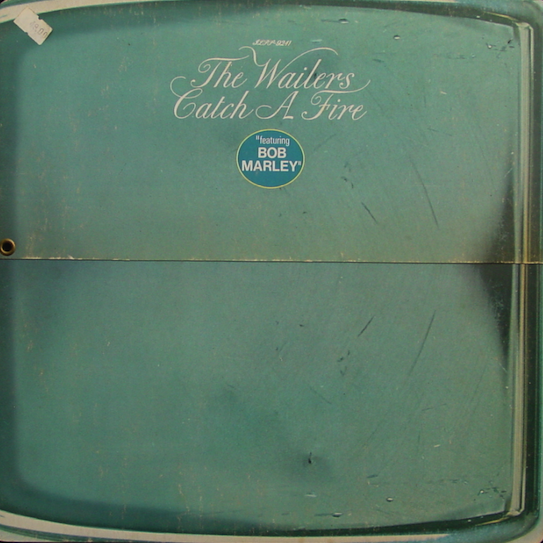
Among the album’s highlights is “Stir It Up,” a song Bob Marley had originally recorded and released as a single in Jamaica in 1967 before revisiting it for Catch a Fire.

Smooth, sensual, and effortlessly melodic, it’s the musical equivalent of a warm Caribbean evening.

So, congratulations to the Knicks on ending one of the longest championship droughts in professional sports.  And thanks for providing an excuse to revisit some of the remarkable music that filled the airwaves the last time New York stood atop the basketball world.

Enjoy… until next week.

Song of the Week – The Pros and Cons of Hitchhiking, Roger Waters

Ignored            Obscured             Restored

In 1984, Roger Waters of Pink Floyd released his first solo album – The Pros and Cons of Hitchhiking.  The album has a concept that is dense and difficult to comprehend.  It seems to have something to do with a man that is suffering from insecurity (?), a midlife crisis (?), and/or paranoia (?).  Who really knows other than Waters.

The concept was originally presented to Pink Floyd in 1977/78 along with The Wall.  Waters asked the band to consider both and choose which one they wanted to pursue for their next album.  They wisely chose The Wall.

One of the details I like about Pros and Cons is the way Waters framed the album as taking place over a specific period — 4:30:18 AM to 5:12:32 AM.  The song titles all have a start time that accurately coincides with the actual running time of the record.  In fact, when it was released on vinyl in ’84, Waters even built in an extra 5 seconds between the ending of Side 1 and the beginning of Side 2 to allow for the listener to flip the record!

The most popular song on the album is the title cut – “The Pros and Cons of Hitchhiking.”

It is the track that sounds the most like a Pink Floyd recording.  The women’s gospel choir in the chorus is a nice touch.

Waters enlisted the help of Eric Clapton and sax players David Sanborn and Raphael Ravenscroft (“Baker Street”) to flesh out his ideas.  Unfortunately, the album liner notes don’t give track-by-track credits.

Another point of interest related to this record concerns the album cover.  Created by Gerald Scarfe, who handled the album artwork for The Wall, it presented a backside view of a high-heeled, naked woman with a backpack, hitchhiking.  The model was soft porn actress Linzi Drew.  The first release showed her exposed butt.  Later pressings had her backside covered by a black rectangle.

Enjoy… until next week.

Song of the Week – Gimme Shelter, Rolling Stones; The Battle of Evermore, Led Zeppelin; Every Picture Tells a Story, Rod Stewart; The Great Gig in the Sky, Pink Floyd

IGNORED OBSCURED RESTORED

A few years ago a film was released called 20 Feet from Stardom (2013). It’s all about the background singers whose fine work has supported so many more famous acts in the studio and on the road.

Today’s post highlights a few of my favorite examples of the value the background singers often contribute.

Merry Clayton, perhaps the most sought background singer in the rock era and one of the featured artists in 20 Feet from Stardom, provided the memorable performance on the Rolling Stones’ “Gimme Shelter” (1969).

In a 2013 interview on Fresh Air with NPR’s Terry Gross, Clayton told her story about the making of “Gimme Shelter.”

Well, I’m at home at about 12–I’d say about 11:30, almost 12 o’clock at night. And I’m hunkered down in my bed with my husband, very pregnant, and we got a call from a dear friend of mine and producer named Jack Nitzsche. Jack Nitzsche called and said “You know, Merry, are you busy?” I said “No, I’m in bed.” He says, “Well, you know, there are some guys in town from England and they need someone to come and sing a duet with them, but I can’t get anybody to do it. Could you come?” He said “I really think this would be something good for you.”

Mick Jagger told NPRs’ Melissa Block on All Things Considered:

“We randomly phoned up this poor lady in the middle of the night, and she arrived in her curlers and proceeded to do that in one or two takes, which is pretty amazing. She came in and knocked off this rather odd lyric. It’s not the sort of lyric you give anyone–‘Rape, murder/It’s just a shot away’– but she really got into it, as you can hear on the record.”

Clayton later lost her pregnancy to a miscarriage. Though unrelated, the association with “Gimme Shelter” made it very difficult to listen to the song for many years.

In 1970 Led Zeppelin released their acclaimed 4th album. “Stairway to Heaven” get the most attention but deep cut “The Battle of Evermore” is equally worthy. And it wouldn’t be the same without the vocal provided by Sandy Denny.

The song has the flavor of a traditional British folk song, so inviting Sandy Denny – whose pedigree was with Fairport Convention and Fotheringay – was a natural choice. Robert Plant and Denny perform a duet on this song. It is a story that references The Lord of the Rings where Plant plays the role of the narrator and Denny represents the town crier. “… Evermore” is the only Led Zeppelin song that has ever used a guest vocalist. Well played!

Maggie Bell’s effort on Rod Stewart’s “Every Picture Tells a Story” is smaller but no less significant.

She adds harmony on the fabulous fifth verse and, along with John Baldry, sings the “every picture tells a story, don’t it” line that repeats through the end of the song. But her best part is when Stewart sings the line “Shanghai Lil never used the pill” and Bell spits out the response “she claimed that it just ain’t natural.” That seals the deal for me.

Lastly is Clare Torry’s improvised vocal on Pink Floyd’s “The Great Gig in the Sky.”

Torry was introduced to the band by Alan Parsons, who engineered the classic Dark Side of the Moon at Abbey Road. Initially reluctant, Torry agreed to the session and recorded 2 ½ takes. The final was an edit of all three takes. All pressings of the song since 2005 give Torry co-writing credit for “TGGitS.”

I can’t imagine any of these iconic rock records without the key contributions from these female supporting vocalists.

Enjoy… until next week.