Garnet Mimms was a soul singer of distinction, best known for the original version of “Cry Baby” that Janis Joplin covered. This is my fave of his. The singing is great beginning to end but it’s not even the best thing about it, which is the beat. It rides and it’s funky at the same time, with a big assist from the unknown-to-me rhythm guitar player. He cuts The Drifters by a mile.
I do like my Spofity shuffle and mixes because they do indeed jumble eras and genres up, although the band in question here is one our friend, Kyle Elfrink, of Sirius/XM, another baseball/music junkie, turned me onto.
They would be the Japandroids. And, Kyle was right, for I like them having added a couple of their discs to my continually growing Playlist. Which means their stuff pops up out of nowhere, which is good fun.
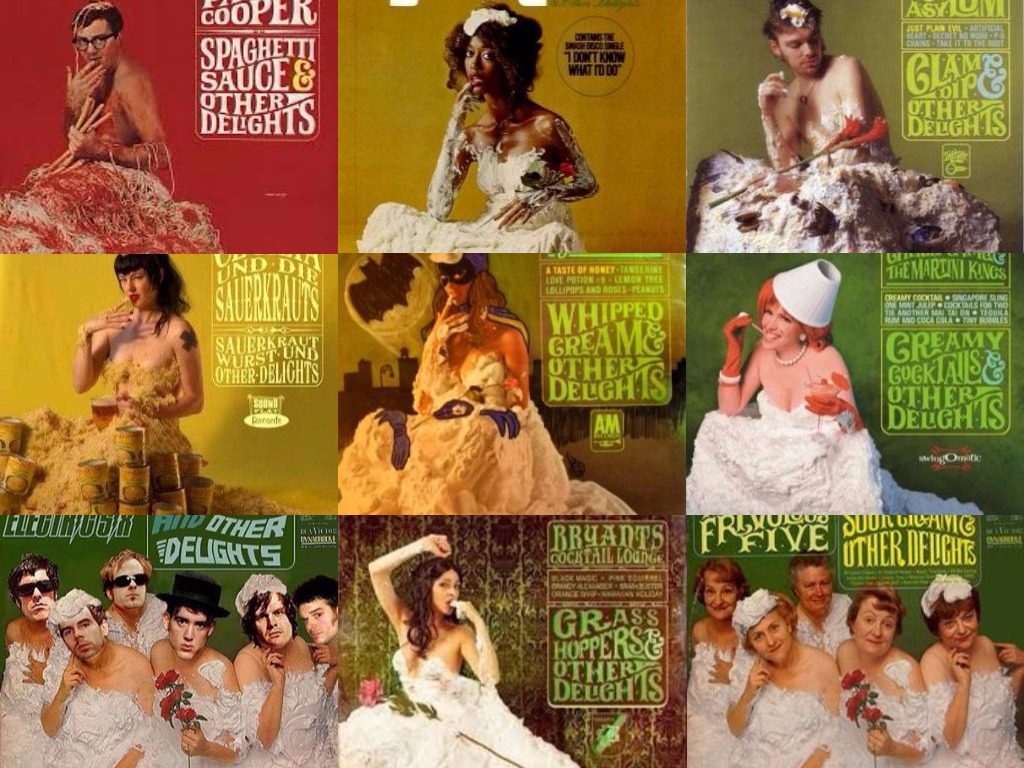
In 1965 Herb Alpert and the Tijuana Brass released their 4th album – Whipped Cream and Other Delights. The album was hugely popular. If you’re a baby boomer, odds are your parents owned a copy; if a millennial, your grandparents. In fact at the height of the British Invasion and Motown the album was able to shift over 6 million copies!!! As a lifelong “crate digger” I think I’ve touched half of them!
The album was as well known for its provocative cover as the music it contained. A 3 month pregnant model named Dolores Erickson (now in her 80s) posed under a pile of shaving cream for the shoot. Her “come hither” expression and the illusion of nudity under that cream was a turn on for adult and adolescent men and no doubt helped sales.
The iconic cover inevitably led to a number of parodies, a sampling included below.
“Whipped Cream” was written by Allen Toussaint under the pseudonym Naomi Neville, his mother’s name. (He also credited the oft recorded “Fortune Teller” to “her.”)
The music was performed by the famed LA session players known as the Wrecking Crew. Artists that played on this album included Hal Blaine, Carol Kaye and Leon Russell (using the name Russell Bridges).
Even if you never heard this album, “Whipped Cream” may sound familiar to you. That’s because it was the music used on The Dating Game TV show as the lead in music when introducing the bachelorettes.
Just found out about this today. A new album at the end of August (it’s been an excessively long time) excites me greatly. Not sure about this yet; I’ll have to see how it grows on me. For now I’ll say “catchy.”
The Residents were/are a band I always wished I liked more. This is one of their defining moments. If nothing else, one could never call The Residents unoriginal or boring.
I thought hard during the last presidential campaign if I had ever seen a political ad that appealed to me more in substance and presentation than this wonderful Bernie Sanders ad which features the ridiculously beautiful Paul Simon penned song, America.
It is just a 1:00 minute splash, but so effective, somewhat because the editing feeds right into Simon’s composition, which is indeed such beautiful poetry, the whole thing just sort of transcends the words of almost any other song/ad I can think of.
The whole tune came on my shuffle the other day as I was heading off the golf links and America is also a great car tune; that is, a song that is great to listen to while driving, so I decided to drop a new category for songs that are a great listen on a road trip.
I guess it goes without saying that arguably the greatest of the “Car Tunes” is Roadrunner by Jonathan Richman and the Modern Lovers, a song that has been featured here before, but another great reflection of travel and riding and life and the open road is Lucinda’s Williams fantastic painting of a tune, Car Wheels on a Gravel Road from the album of the same name.
As it was, Car Wheels popped onto my shuffle right after America the other morning making this whole mess fall together in some kind of prophetic way, but make no mistake, Williams words are just as beautiful and evocative as Simon’s, which is indeed saying something.
So, what else kills in the car on that long ride? Radar Love? Don’t Fear the Reaper? You tell me.
Best song by this band. Multi-percussion fell out of fashion in rock and in soul too, if you count rap as soul. I mean, there are rap songs with lots of percussion but they are few, and punk pretty much wiped out the woodblocks, cowbells and timbales not to mention congas and bongos. It didn’t die altogether, Talking Heads come to mind, but lying dormant there are unexplored possibilities.
When we were 14-15 we used to sing and bang anywhere and anytime. We had this song down, harmonies and cross-rhythms on the money. No selfies in those days; too bad.
Today’s SotW is by the heavy riffing, Long Island band Blue Öyster Cult and comes in two versions.
“I’m On The Lamb But I Ain’t No Sheep” was on BÖC’s 1972 eponymous debut.
The song was reworked and given a new title – “The Red & The Black” – for their second release, 1973’s Tyranny and Mutation.
“The Red & The Black” opens with what sounds like a song “ending” and then kicks right into a blast furnace, fast tempo rocker. After two rounds of verse/chorus comes a blistering guitar solo by Buck Dharma. At about 3 minutes in the bass takes a short solo but continues to propel the song forward all the way through to the end.
The song is a tribute to the Canadian Mounted Police and has become a staple of the band’s live shows in “The Red & The Black” format.
It is a prototypical hard rock performance in the genre that was popularized by bands like Blue Cheer, Black Sabbath, Alice Cooper and Hawkwind.
BÖC was also the first band to utilize the umlaut in their name. This went on to become a heavy metal trademark, copied by other bans such as Motörhead, Mötley Crüe, Queensrÿche and most effectively by the parody group Spın̈al Tap.
Harvey Mandel is a guitarist that languishes in relative obscurity when he really should be a household name.
His career began in the mid-60s playing blues guitar with luminaries such as Charlie Musselwhite, Barry Goldberg, Elvin Bishop and Graham Bond. He was invited to join Canned Heat when lead guitarist Henry Vestine quit in 1969. Mandel’s third gig with the band was at Woodstock!
Next he joined John Mayall for two albums – the now classics, USA Union and Back to the Roots. The musicians he connected with through Mayall led to a short lived band called Pure Food and Drug Act. Their only album was critically acclaimed but never troubled the charts.
In 1975, the Rolling Stones auditioned him to replace Mick Taylor – the job that Ron Wood won. Mandel played on two songs (“Hot Stuff” and “Memory Motel”) on the Stones “audition” album Black and Blue that also featured Woody and Wayne Perkins on other cuts.
But if Mandel is famous for anything, it is for developing the two-handed fretboard tapping technique that was later broadly popularized by Eddie Van Halen. (Mandel acknowledges picking up the technique, in a more rudimentary form, from fellow PFaDA bandmate Randy Resnick.) He introduced it on his 1973 solo album Shangrenade on songs such as “Fish Walk.”
Shangrenade was ahead of its time. If you’re a fan of Jeff Beck’s jazz/rock fusion instrumentals on Blow by Blow (1975), you will love Shangrenade as it explores much of the same landscape.