Today’s SotW is another installment in my “Rare Record Series.” It is “I’ve Found Someone of My Own” from the self-titled soul classic by Smoked Sugar.
Smoked Sugar was a 70’s soul/R&B group in the style of their contemporaries, The Chi-Lites. Their 1975 album received favorable critical notices but never connected with the music buying public. Why, I don’t understand.
“I’ve Found Someone of My Own” is a remake of the 1971 hit by the Free Movement. But where the Free Movement’s version had a dinner club feel (smooth with flute accompaniment) Smoked Sugar’s take is a grittier, southern soul take – like a lost Al Green cut. It’s wonderful!
The vinyl album is still pretty rare and commands prices from $16-50 on Discogs, though prices have come down since the record was released on CD in 2012.
In 1965 Herb Alpert and the Tijuana Brass released their 4th album – Whipped Cream and Other Delights. The album was hugely popular. If you’re a baby boomer, odds are your parents owned a copy; if a millennial, your grandparents. In fact at the height of the British Invasion and Motown the album was able to shift over 6 million copies!!! As a lifelong “crate digger” I think I’ve touched half of them!
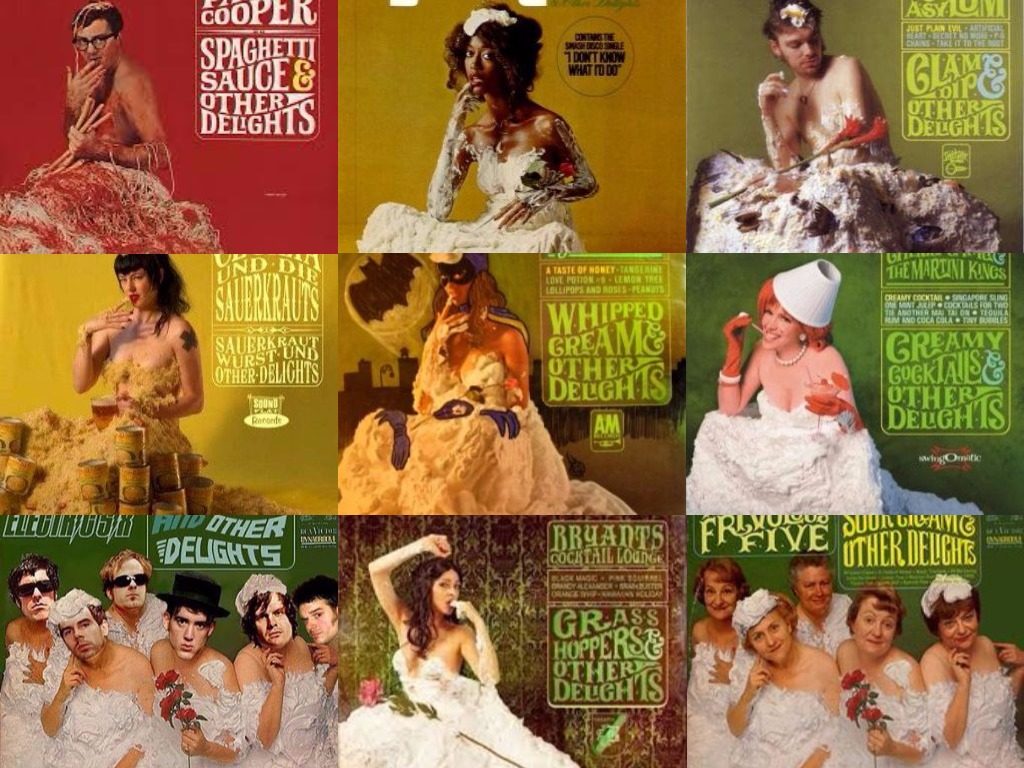
The album was as well known for its provocative cover as the music it contained. A 3 month pregnant model named Dolores Erickson (now in her 80s) posed under a pile of shaving cream for the shoot. Her “come hither” expression and the illusion of nudity under that cream was a turn on for adult and adolescent men and no doubt helped sales.
The iconic cover inevitably led to a number of parodies, a sampling included below.
“Whipped Cream” was written by Allen Toussaint under the pseudonym Naomi Neville, his mother’s name. (He also credited the oft recorded “Fortune Teller” to “her.”)
The music was performed by the famed LA session players known as the Wrecking Crew. Artists that played on this album included Hal Blaine, Carol Kaye and Leon Russell (using the name Russell Bridges).
Even if you never heard this album, “Whipped Cream” may sound familiar to you. That’s because it was the music used on The Dating Game TV show as the lead in music when introducing the bachelorettes.
Today’s SotW is by the heavy riffing, Long Island band Blue Öyster Cult and comes in two versions.
“I’m On The Lamb But I Ain’t No Sheep” was on BÖC’s 1972 eponymous debut.
The song was reworked and given a new title – “The Red & The Black” – for their second release, 1973’s Tyranny and Mutation.
“The Red & The Black” opens with what sounds like a song “ending” and then kicks right into a blast furnace, fast tempo rocker. After two rounds of verse/chorus comes a blistering guitar solo by Buck Dharma. At about 3 minutes in the bass takes a short solo but continues to propel the song forward all the way through to the end.
The song is a tribute to the Canadian Mounted Police and has become a staple of the band’s live shows in “The Red & The Black” format.
It is a prototypical hard rock performance in the genre that was popularized by bands like Blue Cheer, Black Sabbath, Alice Cooper and Hawkwind.
BÖC was also the first band to utilize the umlaut in their name. This went on to become a heavy metal trademark, copied by other bans such as Motörhead, Mötley Crüe, Queensrÿche and most effectively by the parody group Spın̈al Tap.
Harvey Mandel is a guitarist that languishes in relative obscurity when he really should be a household name.
His career began in the mid-60s playing blues guitar with luminaries such as Charlie Musselwhite, Barry Goldberg, Elvin Bishop and Graham Bond. He was invited to join Canned Heat when lead guitarist Henry Vestine quit in 1969. Mandel’s third gig with the band was at Woodstock!
Next he joined John Mayall for two albums – the now classics, USA Union and Back to the Roots. The musicians he connected with through Mayall led to a short lived band called Pure Food and Drug Act. Their only album was critically acclaimed but never troubled the charts.
In 1975, the Rolling Stones auditioned him to replace Mick Taylor – the job that Ron Wood won. Mandel played on two songs (“Hot Stuff” and “Memory Motel”) on the Stones “audition” album Black and Blue that also featured Woody and Wayne Perkins on other cuts.
But if Mandel is famous for anything, it is for developing the two-handed fretboard tapping technique that was later broadly popularized by Eddie Van Halen. (Mandel acknowledges picking up the technique, in a more rudimentary form, from fellow PFaDA bandmate Randy Resnick.) He introduced it on his 1973 solo album Shangrenade on songs such as “Fish Walk.”
Shangrenade was ahead of its time. If you’re a fan of Jeff Beck’s jazz/rock fusion instrumentals on Blow by Blow (1975), you will love Shangrenade as it explores much of the same landscape.
One of the greatest and most tragic musical collaborations was the series of duets recorded by Marvin Gaye and Tammi Terrell. Their glorious list of hits include “Ain’t No Mountain High Enough,” “Your Precious Love” (my favorite), “If I Could Build My Whole World Around You,” “Ain’t Nothing Like the Real Thing,” and “You’re All I Need to Get By.”
But as you well know by now, the SotW is all about providing exposure to the overlooked gems, so today’s feature is “California Soul.”
“California Soul” was written by Ashford & Simpson and recorded by numerous (mostly Motown) acts before Gaye and Terrell took a crack at it. They managed to take it to #56 as the B-side to “The Onion Song.” It was the last single released by the duo (March 1970) and was included on the album Easy.
On October 14, 1967, Terrell collapsed into Gaye’s arms onstage at a concert in Virginia. She was soon diagnosed with brain cancer and was unable to fully continue her career. She received treatments and operations through early 1970 when she finally succumbed to her disease and died about 6 weeks before her 25th birthday.
Controversy has surrounded whether Terrell truly sang on Easy or if her parts were actually sung by Simpson. But I choose to believe Terrell sang, especially since Simpson has continually denied that it was her. (She claims to have provided guide vocals for the weakened Terrell who had to sing while seated in a wheelchair.)
We can only imagine what more great music Gaye and Terrell were destined to make together.
This past week marked the 50th anniversary of the release of The Beatles Sgt. Pepper’s Lonely Hearts Club Band, an album considered by many to be among the first “concept” albums of the Rock era. The album was intended to be seen as a performance by the fictional band that bore the name of the album.
Today it is often lamented by baby boomers that due to the most popular, current music consumption vehicles – streaming and to a lesser degree iTunes libraries – the industry has become a hits only market. Conventional wisdom says that musicians don’t record “statements” and consumers aren’t interested in listening to a whole album by a single artist.
While that may be true in general, it is not without exception. One of my favorite albums of the “aughts” is Separation Sunday (2005) by The Hold Steady. It is a concept album that explored themes of conflict between Christianity and pimps, prostitutes, skinheads and drug addicts.
In March, Hurray for the Riff Raff released their 6th album called The Navigator, itself a concept album. HFTRR is a band led by Alynda Segarra, a woman with a very interesting backstory. (More about that in a bit.)
The Navigator unfolds in two acts and follows Segarra’s alter ego, Navita, who feels the need to escape the city. She visits a bruja (witch) who she asks to put her under a spell for 40 years. Act two begins when she wakes from the spell and discovers the city she once knew is now gone. (It has been gentrified.)
Somewhat autobiographical, it explores the urban territory that has long been the playground for Lou Reed, Patti Smith and Jim Carroll. (This is a departure from earlier HFTRR albums that leaned more toward the Americana of Dylan and The Band.)
Segarra was raised in a Puerto Rican neighborhood of New York. By the age of 17 she was steeped in the writings of the Beat generation and left home see America riding the rails. Caught illegally freight hopping in Ashville, NC, she was facing a month in jail when she was bailed out by friends. She moved on to New Orleans in 2004, found a connection to that city, and stayed there for 10 years. It was there that she started to write songs and sing. In 2014 she moved to Nashville but felt out of place being a city born Puerto Rican – not a southerner. Feeling like an outsider, Segarra began to reconnect to her ethnic roots and returned to New York.
Today’s SotW is “Living in the City” from The Navigator.
“Living in the City” tells the story of the young Navi (Segarra), living in the projects and observing the characters (Big Danny, Mariposa, Gypsy) and behaviors that led her to want to escape. Lyrically “Living in the City” reminds me of Born to Run era Springsteen — like “Meeting Across the River” and “Jungleland.”
Musically the song harkens back to Reed’s “Sweet Jane.”
Overall, The Navigator is a terrific record and proves the concept album is not dead. I strongly recommend you check it out on Spotify or YouTube.
The first time I ever heard (or heard of) The Shins was on the soundtrack for Garden State. The 2004 rom-com’s soundtrack included 2 songs by The Shins but the one that made an immediate impact on me was the memorable “New Slang.” I had a little catching up to do.
By the time their third album — Wincing the Night Away – was released in 2007, I was a solid fan.
This year the Portland, OR based outfit (basically James Mercer and some sidemen) has released its 5th album, Heartworms, its first in 5 years. And it is pretty damned good.
Today’s SotW is the album’s opener, “Name For You.”
In an age where “grabbing pussy” has been normalized by our commander-in-chief and celebrities from Bill Cosby to Bill O’Reilly are accused of serial sexual assaults, it’s about time that we have a song (written by a man) that addresses women’s empowerment. In a recent Mojo interview, Mercer said of the song he was inspired to write because he has three daughters:
“I don’t want women in general to have to put up with frat-boy bullshit. I think I’m more sensitive to the issues because of my family life, but douche-baggery has always pissed me off. I think everyone should own their own sexuality and not be reliant on the society around them for some sort of approval.”
The serious nature of the song is offset by the catchy melody (a Mercer trademark) over a reggae-ish rhythm and effervescent guitars and keyboards.
In the past I’ve written posts on the early, pre-fame songwriting of Cat Stevens and Elton John. Today’s post continues that theme, this time examining the initial work of Warren Zevon.
In the mid-60s Zevon teamed up with Violet Santangelo to write, record, and perform as the folk/rock duo lyme & cybelle (sic). The group recorded for the White Whale label and had moderate success with their single “Follow Me” – produced by Bones Howe who is most well-known for his work with The Association (“Windy”) and the 5th Dimension (“Up, Up and Away”) and later with Tom Waits.
“Follow Me” (co-written with Santangelo) is sometimes cited as one of the earliest psychedelic rock records, an elevated status that allowed it to be included in the Nuggets boxed set.
The connection to White Whale and Howe led to the opportunity for Zevon to present some songs for consideration to label mates The Turtles. “Outside Chance” (also co-written with Santangelo) was released in 1966 but didn’t dent the charts despite the opening guitar riff that borrowed from the Beatles’ “Taxman.”
Another Zevon song, “Like the Seasons”, was the b-side to the Turtles biggest hit, “Happy Together”, that booted the Beatles’ “Penny Lane” out of the #1 chart position in the spring of 1967.
Zevon’s “She Quit Me” was included on the soundtrack to the 1969 Academy Award winning film Midnight Cowboy. It was given a gender switch since it was sung by Leslie (sometimes spelled Lesley) Miller.
Miller was married to MGM record producer Alan Lorber who was partially responsible for the promotion of the “Bosstown Sound” that featured Orpheus and the Ultimate Spinach (yes, that was a real band’s name!) and released several singles on that label.
Zevon put out a full album of his own material in 1969 — Wanted Dead or Alive — that was produced by impresario Kim Fowley. The album went nowhere so Zevon did a career pivot and spent the next 5 years writing songs while working as the band leader for the Everly Brothers touring band and, when he tired of that, moved to Spain and entertained at a bar called The Dubliner.
By the end of ’75 he was back in LA, making friends with the singer/songwriters in David Geffen’s Asylum stable (Jackson Browne, Linda Ronstadt, Eagles) and the rest is history.
My mind has been unnaturally fixated on mortality lately. Today marks the 39th year anniversary of my father’s passing. A few weeks ago I lost a very dear friend of mine at the far too young age of 61 after a short but very nasty battle with cancer. I was fortunate to have a long conversation with her in February when it appeared that her late 2016 surgery had bought her more time. Sadly, she took a terrible turn for the worse shortly afterward.
2016 was an especially hard year for rock deaths. A number of very important artists died during the year – Bowie, Prince, Glenn Frey, Keith Emerson, Paul Kantner, Leonard Cohen, Leon Russell, Greg Lake and George Michael to name a few.
Bowie was first, on January 10th, just 2 days after the release of Blackstar. He was struggling with cancer but chose to keep his illness private and focused on his work. An example to all of us, he worked right up until has passing and left us with one of the best albums of his storied career – yes, even compared to his iconic 70s and 80s classics.
The song “Lazarus”, released as the second single from the album, has often been cited for lyrics that hinted at the artist’s struggle to deal with his illness and impending mortality:
Look up here, I’m in heaven
I’ve got scars that can’t be seen
I’ve got drama, can’t be stolen
Everybody knows me now
In an eerily similar circumstance, Leonard Cohen released his last album – You Want It Darker – on his 82nd birthday, less than two months before his death from complications after a fall.
In an article in the February 2017 issue of Mojo, referring to the title track, Sylvie Simmons wrote:
In his final album, he sang himself back home. “Hineni,” he sang. “I am ready”’, accompanied by the cantor and choir of Congregational Shaar Hashomayim in Montreal, the synagogue his great grandfather founded, and in whose cemetery he would be buried on November 10, in a private ceremony, next to his parents.
Nick Cave & the Bad Seeds also released a superb album in 2016 called Skeleton Tree. The album was initiated in late 2014 but took a much different turn after the death of Cave’s 15 year old, twin son Arthur who fell from a cliff in England in July, 2015. The tragedy initially debilitated Cave but eventually he channeled his grief into a very moving work, the making of which he had documented for a film called One More Time With Feeling.
The album’s opener is “Jesus Alone.”
It includes a line “You fell from the sky, crash landed in a field…” that could only be described as a premonition since it was written before Arthur’s demise.
At least when we have to deal with such sadness, we have exceptional art to help us to process our emotions and feel community with others that have suffered similar experiences.
Good music is good music. How’s that for profundity? I make that point because today’s song of the week may seem to be a very unlikely choice to many of you. It is “Houston” by Dean Martin.
This song is just cool. It is rock and roll. Not in a purist way, but in the same way that James Dean or the Firesign Theater were – and they weren’t even musicians (at least in the main). It’s all about the attitude! Martin and the rest of his Rat Packers had it in spades.
“Houston” was written by Lee Hazelwood, who is most famous for his work with Nancy Sinatra – he wrote and produced “These Boots Are Made for Walkin’” – including their duet on “Some Velvet Morning.” “Houston” made it to #21 on the Billboard pop charts in 1965, a year that was still dominated by the British Invasion groups and Motown.
Lyrically the song is about a good natured guy despite being down on his luck and unable to catch a break.
I got holes in both of my shoes
Well I’m a walking case of the blues
Saw a dollar yesterday
But the wind blew it away
Goin’ back to Houston, Houston, Houston
Good music is good music – no matter where it comes from.


 This past week marked the 50th anniversary of the release of The Beatles Sgt. Pepper’s Lonely Hearts Club Band, an album considered by many to be among the first “concept” albums of the Rock era. The album was intended to be seen as a performance by the fictional band that bore the name of the album.