
You Say You Want a Revolution?

Happy Fourth of July.

Which is always a good day to reflect upon freedom and liberty and justice for all.

As the progeny of immigrants who fled the holocaust–and then whose father was drafted and sent to invade the country from which he fled–I have a pretty serious appreciation for our freedoms, and more frequently than just July 4.

In fact, at this time where revolution and talk thereof, along with the drive for democracy, occurs before our very eyes–in Egypt, as I write–on the television almost daily, I do have some hope for the world and that change, albeit slow, is possible.

So, why am I writing this jingoistic crap on a rock and roll site?

Because music, and literature and the arts play such a serious role in changing our culture and pushing forth the idea of progress.
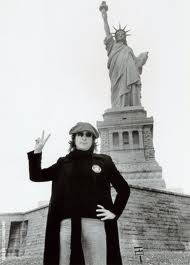
johnnycIn fact, there is no better case in point than John Lennon’s struggle not to become an American citizen, but to simply stay in the States back during the Nixon era.

The FBI, led by J. Edgar Hoover and wanting to protect the Nixon White House and its policies back in the 70’s, worked hard to expel Lennon and Yoko Ono. In fact there is a great PBS American Masters film called LENNONYC that documents Lennon and Ono’s battle with the government. (And keeping things current, I found a pretty good article correlating Lennon’s struggle with the Dream Act.)

So, over the past month, I noted a couple of rock’n’roll documentaries that I wanted to see, and that tie the notions of freedom to music.

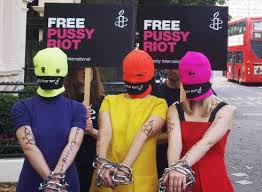
The first is the HBO produced film Pussy Riot: A Punk Prayer, a movie that ostensibly depicts the Russian punk band Pussy Riot and their three members who were sentenced to two years in prison for protesting the return of Vladmir Putin to the head of the Russian government (the charge was “hooliganism”).

I confess that did not watch the whole film because in truth the movie wasn’t really very good, and the music of Pussy Riot was not really the issue anyway. It is clearly freedom of thought and speech and a government’s suppression those freedoms–the same thing in 2013 in Russia, that Nixon wanted to suppress–that was the core.  pussyriot
The other film was the Oscar winning documentary of last year, Searching for Sugar Man:  a movie about the Detroit-based singer/songwriter Rodriguez, his music. For Rodriguez album Cold Fact, virtually unknown in the United States (though distributed through Motown) was as influential among the youth of South Africa during the final throes of Apartheid in the late 1970’s and early 1980’s as anything Bob Dylan produced domestically a decade earlier.

Though both journeys–those of Pussy Riot and Rodriguez–are beyond compelling, yet completely different paths, the influence and notoriety that each propagated due to their respective art is huge. (Interestingly, both artists are identified as rock and rollers, though their music could not indeed be more different.)

coldfact

The point, though, is that just as the US wanted to censor John Lennon, and the South Africans did indeed censor Rodriguez (by the way, Searching for Sugar Man is indeed a terrific movie as well as a wonderful celebration to the human spirit) now, 40 years later, the Russians have worked to suppress Nadezhda Tolokonnikova, Yekaterina Samutsevich and Maria Alyokhina, the three convicted members of Pussy Riot.

What these examples remind us is just how powerful music is, for it can make national governments fearful of performers who simply want to tell their own version of the truth.

I write this remembering that our country is far from perfect; however, at least there are now ideally few of us who need fear being imprisoned for speaking our mind irrespective of which side of the political fence we live or speak (meaning I think Trace Adkins is a xenophobic pig, and that Ted Nugent is an idiot, but I am glad they have the freedom to say and sing what they want).

I think the other points are never underestimate the power of art, which includes music. And, finally, that the struggle for freedom for all the inhabitants of the planet is a long and winding road.

Just a few things to think about as we enjoy our own Independence Day (and, do catch both LENNONYC and Searching for Sugar Man).


The Very Short History Of Supershit 666

“Supershit 666 or Super$hit 666 were a European rock supergroup consisting of Ginger from The Wildhearts on vocals and guitar, Nicke Andersson from the Hellacopters on vocals and drums, Dregen from the Backyard Babies on vocals and guitar, and Swedish producer Thomas Skogsberg on bass.”

I copied that from Wiki.

I got what is supposed to be The Wildhearts’ best album “Earth Vs. The Wildhearts” and was very disappointed (too poppy and stupid-punk, kind of like something like Rancid at times). The Backyard Babies are very inconsistent as well and I think Dregen is crazy for choosing BB over the Hellacopters, because the Hellas were best when Dregen was around. (For a great example, dial up BB’s version of “Star Wars” and compare it to Supershit’s “Star Wars Jr.” In this case, junior beats the crap out of senior.)

Nicke Andersson is a god. He’s the main force behind The Hellacopters, as a guitarist and main vocalist. With SS666, he plays drums, where he originally began with the thrash band Entombed. And play the drums he does. For me, SS666 is a rock drum clinic, especially on the use of the snare. Nicke’s drumming could be what puts the whole thing over the top.

I don’t know Thomas Skogsberg very well, but he’s supposed to be a legendary producer.

Legend has it that this band wrote and recorded everything in one day. They never performed live. Does it get any more rock ‘n’ roll than that?

You can hear it in the recording, with just enough sloppiness to keep things interesting and the producer and other band members talking to one another throughout.

Maybe the whole one-day thing is contrived and they really recorded it in two weeks or something, but, even if that’s the case (hopefully not), it’s still a cool concept.

If you don’t already know, it’s my favorite piece of music of all-time. I can listen to it every day.

Thank you and goodnight.

Some Light Summer Reading

I’m going to be away from Saturday to Saturday and away from the computer as well. I found what I think is a brand new book (yes, a book, not a download of a book) called “Detroit Rock City – The Uncensored History Of Rock ‘N’ Roll In America’s Loudest City” by Steve Miller (no, not THAT Steve Miller).

It’s one of those oral history books – just tons of little quotes from people who were there (I love that format). Of course, Iggy and MC5, but also Alice Cooper and even Ted Nugent, who I liked a lot before he shaved off his beard and eventually morphed into the world’s biggest asshole.

If this paragraph from the Introduction is any indication, I’m going to like it a lot:

“We all read Creem magazine in high school, learning about the real deal in a way that effete bullshit like Rolling Stone could never conceive of. Creem was Detroit; the rest were from, well, somewhere else. Creem wrote about the Stooges more than anyone else. When it came down to Mick Jagger vs. Iggy Pop in the rock-star idolatry sweepstakes, Iggy came out on top every time. He was Detroit. I would puff furiously on my Newport at the notion that anyone outside Iggy could be any more badass. Starting at age fifteen, we listened to the Stooges as we drove in cars on back roads and cradled bottles of Mad Dog 20-20.”

I loved Creem magazine. The first thing I did to my first very own brand new car (1982 Volkswagon Scirocco) was put a Creem Stars Car license plate on the front.

I also will finally write a review of the new QOTSA album when I get back. Meanwhile, enjoy the ride while 40 of pretty much “The Albums You Always Expect On A Greatest Albums Of All-Time List” pass by.

QUOTE: Rick Rubin

“The thing is, when you’re a fan from the outside of something, you can embrace it in a different way than when you’re a fan from the inside. Run-D.M.C. could be sort of gangstery in their own way, pre-gangster rap, because they were suburban kids. Kurtis Blow, who was from Harlem and really around gangsters, he didn’t want to be a gangster. He wanted to look above it and wear leather boots and be more like a rock star. Grandmaster Flash and the Furious Five were really inner-city, hard-life guys, and they wanted to be from outer space.”

From the Archives: 30 Greatest R&R Guitarists (circa 1980)

How much have about 30 years altered this list that was put together by Dave Marsh in the Book of Rock Lists? We have a few guitarists on the site, so I’m interested to see what they think.

Mickey Baker

1. Jimi Hendrix
2. Chuck Berry
3. Mickey “Guitar” Baker (Mickey and Sylvia, sessions)

Steve Cropper


4. James Burton (Elvis)
5. Pete Townshend
6. Keith Richards
7. Scotty Moore (Elvis)
8. Steve Cropper (Booker T. and the MGs)
9. Link Wray
10. Eric Clapton

Other notables when the list was published in 1980/81: Eddie Van Halen (13), Duane Allman (17), Jimmy Page (22), Mick Jones (24), Steve Jones (25), Bruce Springsteen (29).

As much as I love Springsteen and his guitar playing, I wouldn’t have him on this list. I’d put Prince in the top 30, though I don’t know where. I’d have Mick Taylor (29) higher. I’d have Marc Bolan and Mick Ronson on the list. Jimmy Page would be in my top 10 because he wrote so many great riffs but I know that a lot of guitar players think he’s sloppy. I can’t hear it though. I think Tom Morello belongs on the list after seeing him with Springsteen.

I remember talking to Moyer years ago about guitarists and I questioned the extent that leads should influence the rankings and he said that there isn’t a great guitarists who didn’t play great leads. I countered with Keith Richards and Steve had to admit that I had him there. Of course, Richards played, and wrote, many of the greatest riffs in rock history.

Walk Don’t Run Down a Hall of Mirrors

There’s an obit in the New York Times today for Johnny Smith, the guitarist who wrote the song “Walk, Don’t Run.” Smith’s recording of the song didn’t hit, but a few years later Chet Atkins covered it and that led to the Ventures version in 1959, which became a massive hit. Here’s Smith’s version:

The Venture’s version was so big, however, that Robert Stone used the sound of it wafting down New Orleans alleyways as a unifying thread through his great hallucinatory first novel, A Hall of Mirrors. Here is the Venture’s version: