I always have an ear open for a great, new (or old) tune I’ve never heard before. You can never tell where it will come from. Many times before I’ve told stories about the odd circumstances under which a cool song with an interesting backstory has come to my attention. Here’s another one.
A few weeks ago I was invited to a cocktail party in San Francisco’s Mission district by my cousin Emilia V. She’s the event planner for a lifestyle website (1stdibs.com).
While mingling at the party I met one of her colleagues and quickly learned we share a passion for music. He told me he’d heard about a Cat Stevens song that was based on nothing more than a “ping pong” effect and asked if I’d ever heard of it. He’d never heard it and didn’t know the title.
Now I’m quite familiar with Cat Stevens work and this didn’t sound even vaguely familiar to me. So I dug into my “still haven’t listened to” box of records and found two Cat Stevens’ albums – Foreigner and Izitso.
I put Izitso onto the turntable first because it had two instrumentals. When I heard “Was Dog a Doughnut?” on side two, I knew I found what I was looking for.
“Dog…” is an interesting electro pop instrumental that doesn’t sound like anything you would associate with Stevens. Not only is it different, it is funky, especially for its time.
I did a little internet research on the song and found this great article from May 2015 by Christine Kakaire for Red Bull Music Academy Daily. The back story on the record is fascinating. I’d hate to simply paraphrase the whole thing for you here, so I highly suggest you click through to learn all about the song, equipment used and its influence on contemporary electronic and hip hop music.
Most of you associate The Moody Blues with their late 60s/early 70s progressive rock classics like “Nights In White Satin”, “Ride My See-Saw”, “Tuesday Afternoon” and “Balance.” But before that, they were a British Invasion pop band, playing a mix of originals and covers of American R&B (like most of their peers).
This early version of the band included guitarist/vocalist Denny Laine (who went on to greater renown as a member of Paul McCartney’s Wings) and had a #10 hit in the US with the Laine sung “Go Now” in early 1965.
If you’re a Baby Boomer you probably remember this song. If you’re a Gen Xer or Millennial, maybe not so much (unless your dad weened you on oldies radio when you were a toddler).
Still, I’ll bet most of you don’t know that the Moody Blues version of “Go Now” was a cover of an original recording by Bessie Banks (1964). Banks’ “Go Now” is today’s SotW.
It was produced by none other than the great R&B team of Leiber and Stoller. Purists think Banks’ version is the superior one. I love it too and that’s why I’m sharing it with you today. But I also like the Moody’s version. I’m going to cop out and call this one a toss-up.
Several years ago I downloaded a compilation of Cambodian rock music called Cambodian Rocks. I can’t remember what blog I found it on, but I remember that the article noted that the original disc provided very little in the way of song titles, artists or other credits. By the time I found the album most of the missing credits had been identified, but the whole backstory intrigued me.
So I was very excited when a documentary film called Don’t Think I’ve Forgotten: Cambodia’s Lost Rock & Roll and directed by John Pirozzi was being shown in San Francisco and Berkeley last May. Unfortunately it was such a limited engagement that I missed it. But now it’s available on iTunes so I was able to watch it in the comfort of my home recently. It’s not for everyone, but as a student of rock music I found it to be fascinating.
Here’s what I learned:
In 1953, Cambodia received its independence from France. Their new ruler, King Norodom Sihanouk, was a flawed dictator with a few redeeming characteristics. He wanted to modernize Cambodia and had a strong interest in the arts, specifically film and music. Artists in those industries were given tremendous creative freedom even though they reaped very little in terms of financial reward.
By the mid 60s, the Viet Nam war brought Armed Forces radio into the country and exposed them to the eclectic sounds of American rock music. Unencumbered with genre boundaries, the Cambodian rockers mixed French pop, Latin, psych, surf, R&B and Asian melodies into a big, boiling pot of rock and roll stew.
The country’s biggest star was Sinn S, known as the Cambodian Elvis. (With his pop crooning style, he sounds more like the Cambodian Nat King Cole to me.) Yol Aularong had a more authentic Western rock and roll style and merged it with overt political protest lyrics. (Let’s say the Cambodian MC5.)
Ros Sereysothea was the queen of Cambodian rock. Her “I’m 16” is today’s first SotW.
In a 2007 article about Cambodian rock in The Guardian, music journalist Nic Cohn writes of Ros:
Her voice was the perfect teen-dream confection, equal parts heartbreak, flirtation, and true romance. Even though I couldn’t understand a word, she affected me more strongly than any female pop singer since Ronny Spector of the Ronettes…
She was also a canny songwriter, her melodies twisty and surprising, yet instantly hummable…
On “I’m Sixteen”, her greatest hit and the signature anthem of Khmer rock, she sings: ‘Life’s like a flower/Spreading fragrances everywhere.’ So long as she keeps singing, she can almost make you believe it’s true.
This golden age of Cambodian rock lasted until 1975 when the communist Khmer Rouge, led by Pot Pol, captured the capital of Phnom Pehn. They evacuated the city and sent everyone to live the life of agrarian peasants… if you were lucky. Almost 2 million people (about 1/4 of the country’s population) were murdered during their near 4 year reign through 1979. Anyone that was suspected of being middle class, intellectual or artistic was executed in “the killing fields.” People disappeared under suspicious circumstances. That included most of the Cambodian rockers and explains why so little information about them survived.
Fast forward to 1999. Again from Cohn’s Guardian article:
… Ethan Holtzman, a Californian keyboard player, went backpacking in the Cambodian countryside and hitched a ride on the back of a pick-up truck. As Holtzman’s travelling companion, semi-delirious, suffered with dengue fever, the truck driver played a tape of Ros Sereysothea’s ‘New Year’s Eve’. Holtzman was knocked sideways. When he got back to America, he formed a Khmer rock band – himself on Farfisa organ, his brother Zac on guitar, plus drums, bass, and sax – and named it Dengue Fever.
For authenticity, a Khmer singer was needed. Long Beach, California – Little Phnom Penh – is the world’s largest Cambodian enclave outside the homeland, founded by refugees. There, Dengue Fever found Ch’hom Nimol. A popular performer at weddings, she came from a famous family of singers. Though she lacked a little of the range and raw power of Ros, Ch’hom was dazzling in her own right, with the seamless high vibrato characteristic of all the best Khmer female vocalists.
Today’s second SotW is Dengue Fever’s “Tiger Phone Card.”
Musically the song preserves the spirit of the Cambodian Rocks selections. It cleverly takes the form of a conversation between lovers. And I love the economical guitar solo that comes in at about 1:37.
In the mid 2000s I discovered three indie rock bands with “Deer” in their names; Deer Tick, Deerhoof and Deerhunter. I’ve always had a difficult time keeping them straight. Here’s a quickie primer.
Deer Tick – The Providence, RI based band is an indie Americana band. Influences touch on rock, folk and country music.
Deerhoof – A quirky indie rock band led by drummer Greg Saunier (who plays out in front during concerts) and Asian singer Satomi Matsuzaki. They are based in the SF Bay area. Their “Fresh Born” was a SotW in 2008.
Deerhunter – This band is a little harder to pigeon hole stylistically. They were founded by vocalist Bradford Cox (vocals, keyboards, guitars) and Moses Archuleta (drums) in Atlanta and are known for recording songs in a wide range of genres – ambient, noise rock, art rock, punk.
Today’s SotW is from their 2015 album, Fading Frontier. It’s called “Snakeskin” and covers new territory, even for the eclectic Deerhunter – funk.
This song has a heavy groove that’s like a dinosaur stomp through the woods. But the band reverts, somewhat, to their old tricks as the track turns into an ambient wash over the funky bed for the last 2 minutes. It works!
The lyrics reflect the Southern Gothic style of, say, fellow Georgian Flannery O’Connor.
I was born already nailed to the cross
I was born with a feeling, I was lost
I was born with the ability to talk
I was born with a snake-like walk
I was trippin’ now on a city cloak
They were separated then with sunlight shrouds
I was born with a crippled man on my back
I was national, I was geographic black
This weekend marks the 8th Anniversary of the SotW. Thank you for you continued support and feedback. It inspires me to keep on keepin’ on.
Back in November, shortly after Allen Toussaint died, music industry critic Bob Lefsetz dedicated one of his blog posts to his favorite Toussaint covers. It was a comprehensive list of great recordings.
A few weeks ago he posted this response by the great Al Kooper from his “mailbag.”
From: AL KOOPER
Subject: Re: Re-Allen Toussaint
Missa Lefsetz
I was kinda surprised that no one mentioned a rare WB album that Allen produced in the early 70’s self-titled it was called “Browning Bryant”. A young white kid who totally understood New Orleans musica. The opening track has always been one of my fave AT compositions. I told him so when we met at a concert in NYC where each act played just one Dylan song. It was about 8 years ago. I told him I loved that Browning Bryant track he wrote called “Cover Girl.” I wondered if he still recalled it. He started singing it to me and I joined in and we laughed. That was one of my favorite bump-into-somebody-you-cherish moments. Have a listen – Ya might like it.
Since I’d never heard of Browning Bryant I immediately did some research, besides listening to “Cover Girl.”
I learned that “Cover Girl” wasn’t the only Toussaint song Bryant recorded. I fact, his 1974 album had 11 cuts – 3 originals and 8 written by Toussaint! Further, the album was produced by Toussaint and used the New Orleans based R&B group The Meters as Bryant’s backing band.
Also of note, the 6’5” Bryant was only 15 years old when the recording began. I was shocked that I missed an album of this quality for all these years, so I’m presenting a second song this week – “You Might Say.”
If you liked Boz Scaggs’ Silk Degrees, this will be right up your alley.
Thanks to Al Kooper for exposing me (us) to this great, obscure artist and album. But this should come as no surprise since Koop has been doing this for a long time. In fact I’d recommend you check out his podcasts called New Music for Old People.
I’ve been a fan of Mitch Ryder and the Detroit Wheels since they released their first hits back in the mid-60s. My idol Bruce Springsteen was also a big fan, adapting Ryder’s hits into his famous final encore number, “The Detroit Medley” (which you can hear on the No Nukes: The Muse Concerts for a Non-Nuclear Future album).
Oddly, Springsteen’s medley leaves out my favorite Ryder hit – today’s SotW “Sock it to Me Baby” (#6, 1967). Put this one into the Restored category.
“Sock it to Me” is a wild, sweaty dose of Rock ‘n Soul. It has all of the best Detroit has to offer musically. It rocks with MC5 like intensity (check out the guitar break after each “Sock – it, to me baby” section), it has a Motown beat that makes dancing irresistible, and it has that subtle sexual tension that is present in so many of Rock and Roll’s best songs. Ryder’s performance is a damned good imitation of James Brown. And somehow when that slide whistle comes in it sounds just right despite my instinct telling me it should be corny (as it is on Procol Harum’s campy “Mabel”).
This is a party record if there ever was one.
When I began to write this post I wondered when the phrase “sock it to me” first came into the 1960’s lexicon. It was a popular catchphrase often used by Judy Carne on Rowan & Martin’s Laugh-In that first aired in 1968. Then there’s the “sock it to me” background vocal on Aretha’s “Respect.” That was recorded on February 14th, 1967; a little more than a week after Ryder’s song was released on February 4th. So who used it first, Aretha or Mitch? It would appear Mitch, but it’s hard to tell for sure – the matter made a little more complicated since both artists were based out of Detroit. Who knows what each was hearing around town prior to their recording dates?
One last Fun Fact: Winona Ryder chose her stage name when she saw a Mitch Ryder album in her father’s record collection. Interesting, since Mitch’s real name is Bill Levise.
First it was Bowie, then Glenn Frey of Eagles. I have to admit, Eagles weren’t my favorite band. There were times that they rocked out and I could relate, but their soft rock ditties like “Peaceful Easy Feeling” and “Best of My Love” just don’t do it for me.
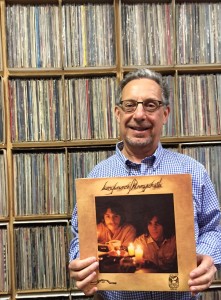
But Frey’s passing allows me the opportunity to pay him tribute by posting about another group he was in – the duo Longbranch Pennywhistle. The self-titled album has been long out of print so it is the second installment of my “Rare Record Series.”
Longbranch Pennywhistle was released in 1969 on the independent Amos label and was the work of Frey and his longtime friend and collaborator, John David (JD) Souther. In fact, they teamed up to write several of Eagles big hits including the aforementioned “Best of My Love”, “New Kid in Town”, “Victim of Love” and “Heartache Tonight.”
SotW is “Run, Boy, Run.” It was chosen because it was written by Frey and reminds me of my favorite Eagles song, “Already Gone”, which was sung by Frey (although written by Jack Tempchin and Robb Strandlund) and contains some of his best ripping guitar solos.
On “Run, Boy, Run” (and “Already Gone”) you can hear some of that working class rock and roll style that Frey must have learned growing up in Detroit and playing with Bob Seger (guitar and vocals on “Ramblin’ Gamblin’ Man”). The song/album also doesn’t suffer from the musical backing they get from session players including James Burton, Larry Knechtel, Jim Gordon, Ry Cooder, and Doug Kershaw. Not a shabby group.
I hadn’t really planned to post about David Bowie today. All week there have been media articles, radio tributes, and playlists to honor his passing. Sirius/XM even turned The Loft into an all Bowie station for a limited time. What more is there for me to add to the conversation?
But a very good friend of mine sent me an email saying he was looking forward to my take on the Bowie legacy so I decided to take a stab at it after all. My slant is to illuminate the various facets of Bowie as a performer, interpreter, writer and collaborator.
I’ll start by simply offering my all-time favorite Bowie song, “Heroes.”
“Heroes” was released as a single but never really achieved meaningful chart success. It was a well-known album cut but wasn’t among his most commercial releases. So I was surprised when I notice that it is the 3rd top Bowie song listened to on Spotify (with over 25 million streams, behind only “Space Oddity” and “Life on Mars”).
I’ve always dug the way it starts off with such power but continues to build and build, even when you think it’s no longer possible.
Next let’s listen to Bowie covering another artist – Bruce Springsteen’s “It’s Hard to Be a Saint in the City.”
Bowie was an early proponent of Springsteen, having recorded two songs (“It’s Hard to Be A Saint…” and “Growin’ Up”) from The Boss’ first album Greetings From Asbury Park, N.J.
There are scores of great covers of Bowie songs by others. Take a listen to “Let’s Dance” by M Ward.
This melancholy version of Bowie’s exhilarating club hit underscores the simple beauty of the song.
Finally, Bowie was always generously shared his talent with other artists, from Bing Crosby (“Little Drummer Boy”) to Mick Jagger (“Dancing in the Street”) to Queen (“Under Pressure”). My pick for a cool collaboration is his effort with Arcade Fire on their “Wake Up.”
Today’s SotW guest contributor is Haley Flannery. I was first introduced to Haley when her father, a lifelong friend of mine, asked me to add her to the SotW distribution list. I have since come to know her as the outstanding author of the Emphatic Hands blog where she professes a fondness for girl bands amongst other things.
Carrie Brownstein published a memoir last year. Though she is now arguably better known as an actress (see Portlandia, Transparent), as well as a writer and cultural critic (for NPR and others), Brownstein devoted the majority of the memoir’s pages to Sleater-Kinney, the punk band that she founded with Corin Tucker in 1994, dissolved in 2006, and reformed in 2014 to release one of 2015’s best albums, No Cities to Love.
It is not surprising that Sleater-Kinney is so vital to Brownstein’s life story. They’re a vital band that has made some of the most singular, electrifying music released in the last two decades. No Cities to Love picks up right where their last album, 2005’s The Woods, left off, exploring the anxieties of living in the modern world, making music, and relationships.
The songs on No Cities to Love are powerful and catchy, none more so than mid-album track “A New Wave,” which is Sleater-Kinney at its most upbeat. Even the music video, a collaboration with the animators of Bob’s Burgers, is pure fun.
No one here is taking notice
No outline will ever hold us
It’s not a new wave
It’s just you and me
When Brownstein sings these lines, and when she sings later of “inventing our own kind of obscurity”, it brings to mind the band’s career-long refusal to be defined. Sleater-Kinney are shapeshifters. They are punks, feminists, mothers (literally and figuratively). They are world-class musicians and intellectuals. They are entertainers. They are uniquely themselves. They were, and still are – as Greil Marcus once called them – America’s best rock band.
I originally wrote this post in May 2008. I decided to repost it because it refers to a concert I saw 40 years ago today. It brings back great memories.
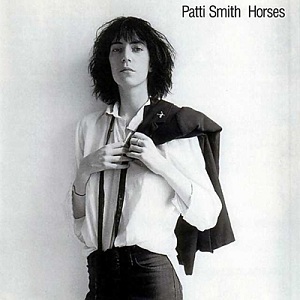
I was a DJ at Boston College’s radio station, WZBC, when Patti Smith’s album Horses was released on November 8th, 1975. I remember seeing the record in the “new releases” bin and being immediately drawn to it. Who was the androgynous woman in the black & white photo on the cover, wearing suspenders, with her coat hanging defiantly over her shoulder? (Of course at the time I wouldn’t have recognized the name of her photographer, Robert Mapplethorpe, even if it had been pointed out to me.)
I listened to that album, and listened again. I’m still listening to it and get a rush every time I hear it, though I acknowledge it is one of those love it or hate it records.
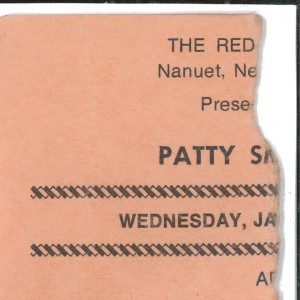
A few weeks later I was back home for Christmas break in Newburgh, NY and learned that Patti would be playing the Red Rail, a small club in Nanuet, NY. A few buddies and I made a white knuckled drive the 40 miles to Nanuet in a massive blizzard. My parents were pissed that I insisted on risking the drive through that terrible storm.
The concert was unbelievable. Patti was in rare form, improvising her beat poetry to the three chord garage punk of her backing band. She was high as a kite and kept complaining that “some dude poured orange juice in my hair backstage.” This YouTube video from 1976 will give you an idea of what it was like to see her that night:
This week’s song is “Break It Up” from that debut record.
It was co written by Tom Verlaine of Television and was supposedly inspired by a dream about visiting Jim Morrison’s grave. It starts with a gentle piano intro. When Verlaine’s guitar comes in at the chorus, it sounds like a ghost haunting a cemetery. I’ve always loved the effect on Patti’s voice when she literally beats her chest during the lyric:
Ice, it was shining.
I could feel my heart, it was melting.
This is emotional stuff. Patti sings as if possessed, her words finding their own rhythm within the steady beat of the music. By the end her wailing sounds like she’s speaking in tongues at a Pentecostal revival. The piano pounds away with the guitars and keeps building all the way through the fade.
I hope you enjoy getting reacquainted with this song as much as I have.


 First it was Bowie, then Glenn Frey of Eagles. I have to admit, Eagles weren’t my favorite band. There were times that they rocked out and I could relate, but their soft rock ditties like “Peaceful Easy Feeling” and “Best of My Love” just don’t do it for me.
 I was a DJ at Boston College’s radio station, WZBC, when Patti Smith’s album Horses was released on November 8th, 1975. I remember seeing the record in the “new releases” bin and being immediately drawn to it. Who was the androgynous woman in the black & white photo on the cover, wearing suspenders, with her coat hanging defiantly over her shoulder? (Of course at the time I wouldn’t have recognized the name of her photographer, Robert Mapplethorpe, even if it had been pointed out to me.)
 A few weeks later I was back home for Christmas break in Newburgh, NY and learned that Patti would be playing the Red Rail, a small club in Nanuet, NY. A few buddies and I made a white knuckled drive the 40 miles to Nanuet in a massive blizzard. My parents were pissed that I insisted on risking the drive through that terrible storm.