Song of the Week – Gimme Shelter, Rolling Stones; The Battle of Evermore, Led Zeppelin; Every Picture Tells a Story, Rod Stewart; The Great Gig in the Sky, Pink Floyd

IGNORED OBSCURED RESTORED

A few years ago a film was released called 20 Feet from Stardom (2013). It’s all about the background singers whose fine work has supported so many more famous acts in the studio and on the road.

Today’s post highlights a few of my favorite examples of the value the background singers often contribute.

Merry Clayton, perhaps the most sought background singer in the rock era and one of the featured artists in 20 Feet from Stardom, provided the memorable performance on the Rolling Stones’ “Gimme Shelter” (1969).

In a 2013 interview on Fresh Air with NPR’s Terry Gross, Clayton told her story about the making of “Gimme Shelter.”

Well, I’m at home at about 12–I’d say about 11:30, almost 12 o’clock at night. And I’m hunkered down in my bed with my husband, very pregnant, and we got a call from a dear friend of mine and producer named Jack Nitzsche. Jack Nitzsche called and said “You know, Merry, are you busy?” I said “No, I’m in bed.” He says, “Well, you know, there are some guys in town from England and they need someone to come and sing a duet with them, but I can’t get anybody to do it. Could you come?” He said “I really think this would be something good for you.”

Mick Jagger told NPRs’ Melissa Block on All Things Considered:

“We randomly phoned up this poor lady in the middle of the night, and she arrived in her curlers and proceeded to do that in one or two takes, which is pretty amazing. She came in and knocked off this rather odd lyric. It’s not the sort of lyric you give anyone–‘Rape, murder/It’s just a shot away’– but she really got into it, as you can hear on the record.”

Clayton later lost her pregnancy to a miscarriage. Though unrelated, the association with “Gimme Shelter” made it very difficult to listen to the song for many years.

In 1970 Led Zeppelin released their acclaimed 4th album. “Stairway to Heaven” get the most attention but deep cut “The Battle of Evermore” is equally worthy. And it wouldn’t be the same without the vocal provided by Sandy Denny.

The song has the flavor of a traditional British folk song, so inviting Sandy Denny – whose pedigree was with Fairport Convention and Fotheringay – was a natural choice. Robert Plant and Denny perform a duet on this song. It is a story that references The Lord of the Rings where Plant plays the role of the narrator and Denny represents the town crier. “… Evermore” is the only Led Zeppelin song that has ever used a guest vocalist. Well played!

Maggie Bell’s effort on Rod Stewart’s “Every Picture Tells a Story” is smaller but no less significant.

She adds harmony on the fabulous fifth verse and, along with John Baldry, sings the “every picture tells a story, don’t it” line that repeats through the end of the song. But her best part is when Stewart sings the line “Shanghai Lil never used the pill” and Bell spits out the response “she claimed that it just ain’t natural.” That seals the deal for me.

Lastly is Clare Torry’s improvised vocal on Pink Floyd’s “The Great Gig in the Sky.”

Torry was introduced to the band by Alan Parsons, who engineered the classic Dark Side of the Moon at Abbey Road. Initially reluctant, Torry agreed to the session and recorded 2 ½ takes. The final was an edit of all three takes. All pressings of the song since 2005 give Torry co-writing credit for “TGGitS.”

I can’t imagine any of these iconic rock records without the key contributions from these female supporting vocalists.

Enjoy… until next week.
Song of the Week – Johnny Have You Seen Her, The Rembrandts

IGNORED OBSCURED RESTORED

Today’s SotW is a power pop classic. It is “Johnny Have You Seen Her” by the Rembrandts.

I probably wouldn’t be so embarrassed to admit that I love this song if the duo of Danny Wilde and Phil Solem weren’t best known for performing the theme song to the 90s sitcom Friends, “I’ll Be There For You.”

But please try to put that aside and listen to this as if you could separate them from Friends. (I admit I’m being a music snob.)

“Johnny…” has Beatlesque harmonies (and that ain’t bad) with ringing guitars that conjure up similarities to Squeeze and Crowded House – who at their best also emulate the Beatles.

Don’t take this all too seriously. It’s just “pure pop for now people.”

Enjoy… until next week.

Song of the Week – Ain’t it a Sin, Charles Bradley

IGNORED OBSCURED RESTORED

Retro soul man Charles Bradley released his third album, Changes, earlier this year and again, the 67 year old former James Brown impersonator does not disappoint. (Bradley saw Brown perform at the Apollo when he was just an early teen and his life was changed forever.)

Today’s SotW, “Ain’t it a Sin” is butt shakin’ funk that doesn’t belie Bradley’s revivalist approach.

On this one, the man christened “the screaming eagle of soul” lets us have it with the full throated refrain:

If you ain’t gonna do me right
I just might do you in
Ain’t it a sin

Asked about that lyric, Bradley responded “… I was saying, ‘Don’t do me wrong, I won’t do you wrong.’” Downright Trumpian!

Way to go Charles. You got me believing that “my mind is goin’ through them Changes.”

Enjoy… until next week.

Song of the Week – Bluebird, Buffalo Springfield, The James Gang, Hookfoot

IGNORED OBSCURED RESTORED

Today’s post is another entry in the Evolution Series. This time focused on Stephen Stills’ “Bluebird.”

“Bluebird” was originally recorded when Stills was with the Buffalo Springfield. Another song supposedly written for Judy Collins (Suite: Judy Blue Eyes being the other), it was released in multiple versions. The first was on Buffalo Springfield Again (1967) and ran about 4½ minutes. It was also released as the follow up single to their big hit “For What It’s Worth” in a version edited down to 2 minutes. In 1973, the band released a 2 disc “greatest hits” compilation simply titled Buffalo Springfield that contained a longer 9 minute version. That’s the first SotW.

This is a vinyl rip because this version has never been released on CD and is currently out of print. The psychedelic Technicolor extended jam, and Stills and Young guitar solos (a preview of what would come from CSNY) begins right about where you would expect the banjo ending to start in the standard album version.

A couple of years later, in 1969, Joe Walsh’s James Gang released their first album, Yer’ Album. This disc contained a slowed down, dreamy 6 minute version of “Bluebird.”

As proof that you can’t keep a good song down, it was recorded again by Hookfoot and chosen as the lead off cut for their 1971 self-titled album. Hookfoot was a band featuring members of Elton John’s earliest touring band – guitarist Caleb Quaye, Ian Duck, Roger Pope and David Glover — all of whom also played on John’s Tumbleweed Connection, one of his best albums.

Their version is a little peppier, funkier and more guitar driven.

Other versions are also available for you to check out. Bonnie Raitt included it on her debut record and Stills, who has been known to recycle his own songs, closed Stephen Stills 2 with “Bluebird Revisited.”

One more thing… For kicks and giggles you should check out this YouTube video of a 1967 episode of the CBS detective show Mannix that features Buffalo Springfield playing “Bluebird” in a “hippy” nightclub scene.

Enjoy… until next week.

Song of the Week – Had 2 Know (Personal), White Denim

IGNORED OBSCURED RESTORED

A few months ago, Austin based White Denim released their 7th album (well, 7th including their debut EP), Stiff. White Denim is an indie rock band from Austin that covers a wide range of musical styles – blues, rock, soul – in their repertoire.

The band was launched in 2006 as a trio – James Petralli (vocals, guitar), Joshua Block (drums), and Steve Terebecki (vocals, bass). In 2010 the band added Austin Jenkins as a second guitarist. But in 2014 Block and Jenkins hooked up with fellow Texan Leon Bridges during a White Denim hiatus, but decided to be a permanent part of his group. For a while that left the status of the group in limbo.

But Petralli and Terebecki hired Jonathan Horne (guitar) and Jeffrey Olson (traps) as replacements and picked up right where they left off.

The band has always had a knack for creative promotional gimmicks to foster a loyal fan following. Their first recordings were self-released on iTunes only. Their EP Workout Holiday was only sold at their gigs. A 2008 release called 11 Songs was sold on their 2008 spring tour as a CD-R. (It was later given a proper release under the title Explosion.)

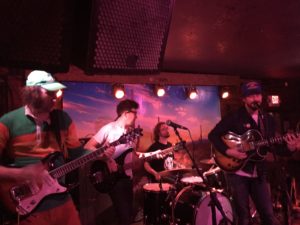
In order to promote the new album, this winter the band did a series of “pop up” shows in small clubs in Austin. The photo below was taken at a show my nephew and cousin attended on February 18th at the Hotel Vegas, a venue that could only accommodate 150 fans.

WhiteDenimOnStage2

Today’s SotW is “Had 2 Know (Personal)” from Stiff.

This is the first song on the album and kicks it off like horses coming out of the starting gates at Churchill Downs. It has a classic rock sound, much like contemporaries The Black Keys – big guitar riffs and strong vocals. These good ‘ol boys are throwing a party and all you have to do is sing along to be a part of it.

If you don’t believe me just watch the video of them playing the song in a local music store that the band produced in April. The tablature scrolled across the bottom so viewers could learn to play it and upload their own versions to the band’s web page, Instagram or Twitter accounts by May 6th.

They promised to award a signed vinyl copy of Stiff, a limited-edition tour poster and a set of custom guitar picks to the winning musicians making the best version.

Enjoy… until next week.

Song of the Week – Taurus, Spirit

IGNORED OBSCURED RESTORED

Back in February 2009 I wrote a post featuring “I’m Confused” by Jake Holmes. I pointed out that “Dazed and Confused” by Led Zeppelin was a blatant rip off of Holmes’ song.

In fact, Led Zeppelin’s Jimmy Page and Robert Plant have a long history of lifting other people’s riffs or lyrics and repurposing them, often very creatively, for songs that they’ve claimed writing credits.

To some, this is just an extension of the old folk/blues tradition of handing songs down from one generation to another – add a new verse here, alter the chords or melody there. All harmless, no?

To others it’s plagiarism and causes economic harm to the original copyright holder. A prime example is Zeppelin’s first big hit, 1969’s “Whole Lotta Love.” The lyrics are very similar to a 1962 Muddy Waters song, “You Need Love”, written by Willie Dixon.

You’ve got yearnin’ and I got burnin’
Baby you look so ho sweet and cunnin’
Baby way down inside, woman you need love
Woman you need love, you’ve got to have some love
I’m gon’ give you some love, I know you need love

Sound familiar? The courts thought so and Led Zeppelin settled out of court with Dixon in 1985 for an undisclosed sum. As part of the settlement, Dixon’s name was added to the credits for “Whole Lotta Love” on all subsequent releases.

This week Page and Plant are in court again. This time it’s over the intro to their timeless classic “Stairway to Heaven.” Some claim it bears a striking resemblance to the instrumental “Taurus”, today’s SotW, by the California psych band Spirit.

So far the plaintiffs – the estate of the song’s author, Randy California – are trying to establish that Page and Plant heard the song on record or in performances before they wrote “Stairway to Heaven.” Page, under sworn testimony has denied it. Rolling Stone has been reporting on the trial. You can read their coverage here:

Rolling Stone – Stairway to Heaven trial part 1

Rolling Stone – Stairway to Heaven trial part 2

For my part, I hear the similarity, but in this particular case I find it a stretch to concede that there’s enough of a case to award Spirit a favorable judgement and monetary damages. Whatever influence he may have nicked from “Taurus”, Page takes “Stairway to Heaven” way further. No contest here.

But it will still be interesting to see how it is decided in the courts.

Enjoy… until next week.

Song of the Week – Revolution Blues, Neil Young

IGNORED OBSCURED RESTORED

Today’s post is on the final release of Neil Young’s Ditch Trilogy – On the Beach.

As you may recall, the first two albums in the trilogy dealt with the heroin overdose deaths of bandmate Danny Whitten and roadie/friend Bruce Berry. But despite preparing for highly anticipated tour with CSNY in 1974 (documented in a boxed set released in mid-2014) things still weren’t looking up in Young’s personal life.

He separated from his wife, actress Carrie Snodgrass, and learned that their son had been diagnosed with cerebral palsy. He escaped to Malibu and began work on the paranoid sounding On the Beach. He was quoted as describing the album as “probably one of the most depressing records I’ve ever made.” Now that’s saying something, coming from “Don’t Let it Bring You Down” Neil.

For this album, Young asked some friends to help out. Rick Danko and Levon Helm, of The Band, contributed; as did Graham Nash and David Crosby. The album was recorded at LA’s Sunset Sound studio and was fueled by “honey slides” – a concoction of hash cakes soaked in honey. Young’s manager, Elliott Roberts, was quoted as saying honey slides were “way worse than heroin.”

It’s this druggy environment that produced today’s SotW, “Revolution Blues.”

On this track Young is at his most vicious, taking his suspicions of the LA star system he was retreating from to a terrifyingly scary place.

Well, I hear that Laurel Canyon is full of famous stars,
But I hate them worse than lepers and I’ll kill them in their cars.

Danko and Helm hold down the rhythm on this one, giving the song a little more funk than most of Young’s work.

In a 1975 interview with Rolling Stone’s Cameron Crowe, Young said “You got to keep changing. Shirts, old ladies, whatever. I’d rather keep changing and lose a lot of people along the way. If that’s the price, I’ll pay it. I don’t give a shit if my audience is a hundred or a hundred million. What sells and what I do are two completely different things.”

That just about summarizes his approach to the albums that make up the Ditch Trilogy. Confounding to fans upon their release, but regarded in the highest esteem with the benefit of 40 years hindsight.

Enjoy… until next week.

Song of the Week – Tonight’s the Night, Neil Young

IGNORED OBSCURED RESTORED

Neil+Young+1973+PhotoLast week’s post was about the first album in Neil Young’s “Ditch Trilogy” – Time Fades Away. The next is Tonight’s the Night. This may be somewhat confusing to some Young fans because TTN was released after On the Beach, even though it was recorded before. But it makes more sense to deal with them in chronological order in the context of the Ditch Trilogy story.

Part 1 of the this series dropped off with the live album Time Fades Away, recorded on the tour that began right after the heroin overdose death of friend and bandmate Danny Whitten in November 1972. A few months later, in June 1973, tragedy would strike again when Young’s friend and roadie Bruce Berry would also succumb to the drug.

This time Young reacted by pulling together that band to grieve and record. They would hang out at his ranch and play pool and party from early evening until the wee hours of the morning when they would turn their attentions to recording. The resulting TTN is a ragged set of cuts, even by Young’s standards. So the album was finished in just a few days in August 1973 at Studio Instrument Rentals, a rehearsal space owned by Berry’s brother Jan (as in Jan of Jan and Dean).

In Young’s book Waging Heavy Peace, he describes TTN as “a wake of sorts.” He admits the LP was “recorded in audio verite, if you will, while completely intoxicated on Jose Cuervo tequila.”

The SotW has got to be the title song.

You can feel the pain in Young’s voice as he bios the life and death of Berry, especially the way he yowls the lyrics in the final verse.

Bruce Berry was a working man
He used to load that Econoline van.
A sparkle was in his eye
But his life was in his hands

Well, late at night
when the people were gone
He used to pick up my guitar
And sing a song in a shaky voice
That was real as the day was long.

Early in the mornin’
at the break of day
He used to sleep
until the afternoon.
If you never heard him sing
I guess you won’t too soon.

‘Cause people let me tell you
It sent a chill
up and down my spine
When I picked up the telephone
And heard that he’d died
out on the mainline.

The mixing for the sessions was tortured. Ultimately the tapes were put away for two years before they were dusted off and finally released, thanks in part to The Band’s Rick Danko. Danko was previewing a tape of Young’s latest album Homegrown (still unreleased) in early 1975. The TTN recordings were on the same tape. When Danko heard TTN he said “You ought to put THAT out!” So he did, in June 1975.

In Waging Heavy Peace Young also says “The album was risky and real. It was a real mess of a recording, with no respect given to technical issues, although it sounds like God when played loud…”

Turn it up!

I’ll post he final installment of the Ditch Trilogy – On the Beach – next time.

Enjoy… until next week.

Song of the Week – Don’t Be Denied, Neil Young

IGNORED OBSCURED RESTORED

Between February 1972 and April 1973 Neil Young recorded three of his darkest and most misunderstood albums. Coming off the success of his work with Crosby, Stills and Nash, then his blockbuster country rock album Harvest (1972), he had the music world eating out of his hand. He even had a #1 hit with Harvest’s “Heart of Gold.”

But Young famously wrote in the liner notes to his Decades compilation: “‘Heart of Gold’ put me in the middle of the road. Traveling there soon became a bore so I headed for the ditch.” This quote is responsible for the next three albums – Time Fades Away, Tonight’s the Night and On the Beach – to become known as “The Ditch Trilogy.”

When Time Fades Away was released, fans expecting the follow up to Harvest to contain more material in the singer/songwriter vein were caught by surprise. Was Young intentionally trying to sabotage his own career? Clearly, they weren’t aware of the anguish Young was facing at the time – the first hint of which he tossed out on Harvest’s “The Needle and the Damage Done” – a song that bore his observations of the effects of bandmate Danny Whitten’s heroin addiction.

In fact, Young and his band were rehearsing for a tour to promote Harvest at his ranch south of San Francisco when Whitten’s substance abuse caused him to struggle to learn and play his parts. Though Young tried to help him out, he was finally persuaded it wasn’t going to work out. He gave Whitten $50 bucks and a ticket back to LA. That night Whitten ODed and died. Young felt responsible.

But the tour was about to begin, so Young headed out on the road with no time to grieve. Instead, he dropped the material he was supposed to promote and instead played a set of loud, menacing, new songs that were a better reflection of his mood. That became the live album Time Fades Away.

The signature song from Time Fades Away is “Don’t Be Denied”, penned the day after Whitten died.

Its autobiographical lyrics cover Young’s journey from his father’s abandonment to schoolyard bullying, to rock and roll stardom. But he ruefully concludes:

Well, all that glitters isn’t gold
I know you’ve heard that story told.
And I’m a pauper in a naked disguise
A millionaire through a business man’s eyes.

Part 2 of the trilogy – Tonight’s the Night – is coming next week.

Enjoy… until next week.