The enigmatic Scott Walker died on
Friday, March 22nd, although the news was not released until this
week. Walker, who achieved more fame and
fortune in the UK than here at home in the US, cultivated a 40-year career in three distinct phases.
The first was with his band, The Walker Brothers. They were sort of a mid-‘60s version of a boy band and had a couple of hits here and in the UK. “The Sun Ain’t Gonna Shine Anymore” is a classic that often draws comparisons to the hits of the Righteous Brothers.
Starting in 1967, Walker released four
solo albums, creatively titled Scott,
Scott 2, Scott 3, and Scott 4. In this period, Walker moved toward a more
crooning style of music featuring a mix of originals and covers – frequently
favoring songs written by Jacques Brel.
“Jackie” was the lead track from Scott 2. It was written by Brel and was released as a single in late 1967.
Lyrics that referenced “authentic
queers and phony virgins,” bordellos, whiskey, and opium, especially in ’67,
made clear that Walker’s teen idol days were behind him.
Later, in the ‘90s, Walker moved even
farther out of the mainstream and recorded works that would most aptly be
described as avant-garde. This became increasingly evident with each
album, culminating with his final release, Bish
Bosch (2012).
A wonderful documentary of Walker’s
career – Scott Walker – 30th
Century Man – was released in 2006.
It is available for rent on YouTube, Google Play and Amazon Prime. It is worth checking out.
David Bowie was the executive producer
of the documentary. He often professed
his admiration for Walker. Influence on
Bowie’s more experimental recordings such
as his final release, Blackstar, can
be traced directly back to Walker – musically and the vocal style of their
similarly matched baritone voices.
Can we all agree on one thing – that
there is too much gun violence in the world today. Muslim extremists killing “infidels,” racists
going into churches, synagogues and
mosques to kill worshipers, and just plain crazies shooting people at schools,
workplaces and concerts!
Enough is enough. “People, I just want to say, you
know, can we all JUST get along?”
Today’s SotW was written about a very
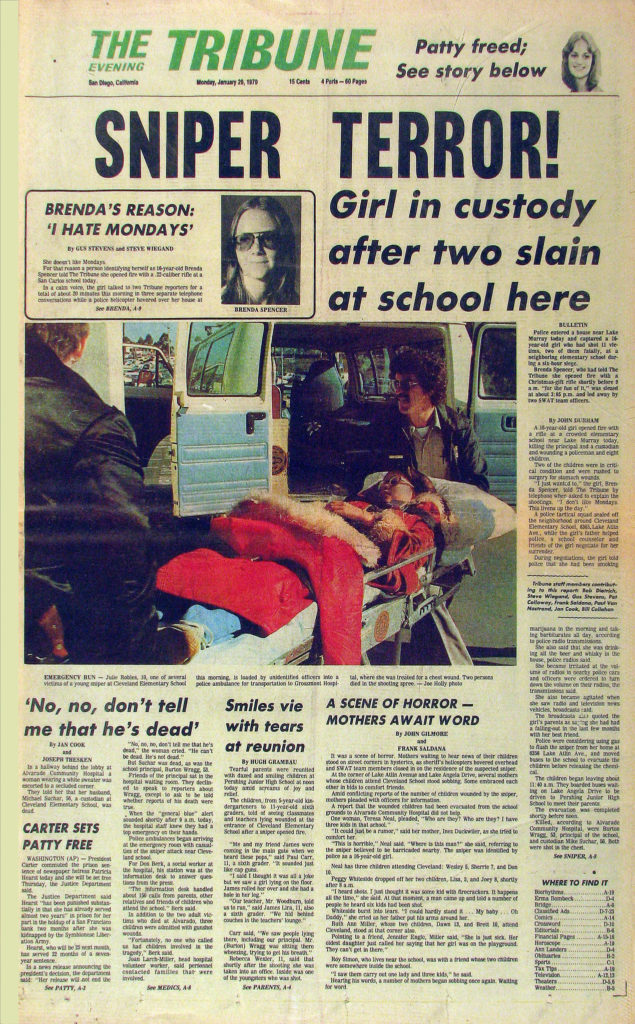
early school shooting that occurred 40 years ago, on January 29, 1979. On that day, a 16-year-old girl named Brenda
Ann Spencer opened fire on the children arriving for the day’s lessons at the Cleveland Elementary
School in the Lake Murray section of San Diego.
Two men (the school principal and a custodian) were killed. Eight children and one adult were injured.
In a telephone interview, a reporter
with The Evening Tribune asked
Spencer why she did it. She responded, “I
just don’t like Mondays… this livens up the day.”
Bob Geldof and Johnnie Fingers, of the Irish band The Boomtown Rats, used this awful backstory to write the song “I Don’t Like Mondays.”
“… Mondays” was a #1 hit in the UK but only
managed to reach #73 here in the US – though it did receive quite a bit of
airplay in the US on college campuses and alternative rock radio.
The piano
based composition renders it a perfect vehicle to be taken up by Tori
Amos, as she did on her 2001 covers album, Strange
Little Girls.
After 40 years, what have we
learned? Mass shootings seem to happen
more and more frequently each year. “People,
I just want to say, you know, can we all JUST get along?”
I generally don’t have much respect for
the Grammys. They have a long history of
picking one-hit-wonders for Best New Artist (Starland Vocal Band, Milli
Vanilli) and awarding Album of the Year to iconic artists long after they
released their best work (Dylan, Clapton, Bonnie Raitt). Not to be too cynical, I must admit there
have also been some very good choices in both of those categories that have
made amends for their boo-boos.
Last month, the 2019 award for Album of the Year went to Golden Hour by Kacey Musgraves, a great choice. Two songs from the album, “Butterflies” and “Space Cowboy”, also won Grammys – for Best Country Solo Performance and Best Country Song.
Musgraves has the rare quality of
mainstream popularity with a bit of rebel mixed in. While primarily a conventional country
artist, she bucks the stereotypical demographic
of country music fans with her open position supporting LGBT rights and a
fondness for booze (she and her band drink a tequila shot before each show), weed
and the occasional psychedelic (she openly admits that she wrote “Mother” on
acid and has taken mushrooms).
This is an image she cultivated since
the release of her first album Same
Trailer Different Park (2013) that included the song “Follow Your Arrow”
with the lyrics:
Make
lots of noise
Kiss lots of boys
Or kiss lots of girls
If that’s something you’re into
When the straight and narrow
Gets a little too straight
Roll up the joint, or don’t
Just follow your arrow
Today’s SotW is “Slow Burn,” the opening track from Golden Hour.
Regarding “Slow Burn,” Musgraves told Rolling Stone:
“It’s an idea I can apply to a lot of different areas of my
life,” she says, taking a break from editing a new video. “I want to be here
for a long time doing what I love, and I don’t feel I need to try to be the
biggest I can be, the quickest. And I even thought of a good drink that you sip
on for a long time. Or a slow burn of a relationship that starts with a little
bit of a spark and doesn’t burn out too quick.”
There’s something about the arrangement of this song that reminds me of “Casimir Pulaski Day” from Sufjan Steven’s Illinois which in turn reminded me of Neil Young’s “Old Man” (maybe it’s the banjos).
Dig in to Golden Hour and the rest of Musgraves’ catalog. You won’t regret it.
Today’s SotW is one of the most
challenging I’ve ever posted. I know
it’s not for everybody, but the SotW wasn’t started to share hit songs that will
be liked by the greatest numbers of people.
It was created with the goal of bringing new and different music
(Ignored Obscured Restored), that I find worthwhile, to open-minded music lovers – that’s YOU!
So, what do I have up my sleeve? How about a 22-minute instrumental excursion
through Eastern and Western musical styles, by just a guitarist and a jazz drummer?
Today’s SotW is “Blend,” by Sandy Bull, from the 1963 album Fantasias for Guitar and Banjo.
This largely improvised piece covers a
range of genres, including classical, folk, jazz, raga and psychedelic rock. It has been reported that Steve Winwood has
given Bull some credit for leading Traffic toward its psychedelic roots. That also leaves me wondering if “Blend” may
have provided inspiration to Jimmy Page for Led Zeppelin compositions like
“Kashmir” or “In the Light.”
The drums were played by jazzman Billy
Higgins, whose best work was in collaboration with Ornette Coleman.
Did anyone make it through the full 22
minutes? If yes…
February 28th brought Black
History Month 2019 to a close. Perhaps
it was fitting that last Sunday’s Academy Awards were amongst the most diverse
ever witnessed. Oscar nominations and
winners in many categories included films focused on African American
casts/themes such as Black Panther, BlacKkKlansman, and If Beale Street Could Talk.
And in a surprise to most, Green
Book walked away with the award for Best Picture.
This is progress, though still more
needs to be done before we achieve a truly color-blind
society.
This subject caused me to reflect on the
work of Curtis Mayfield, a pioneer in
writing and recording songs that reflected the condition of Blacks in the
US. Long before Marvin Gaye (What’s
Going On, “Inner City Blues”) or Stevie Wonder (“Living for the City”) were
laying it out there, Mayfield was releasing gospel-tinged,
message songs like “Keep on Pushing” (1964), “People Get Ready” (1965),
“We’re a Winner” (1968), “Choice of Colors” (1969), and “We the People Who Are
Darker Than Blue” (1970). Some of these
may have even inspired James Brown to become more politically strident with
songs like “Say it Loud, I’m Black and I’m Proud” (1968).
I was tempted to select a song from Mayfield’s soundtrack to Super Fly, in keeping with the Academy Awards theme. But instead, I’ve chosen something you’re less likely to have heard, in keeping with the black history/political songs (and SotW) themes.
The consistency of Mayfield’s catalog is
impeccable. Despite the steady quality
of his releases, shortly after the success of Super Fly, his already modest audience began to wane.
In 1975, Mayfield released the terrific There’s No Place Like America Today. Even before you get to the music, the album cover conveys that you are about to hear something special. It is a variation on a famous photograph taken by Margaret Bourke-White called “At the Time of the Louisville Flood.”
Mayfield’s team colorized it and changed the wording to fit his album. But the1937 image still suited the status of Blacks in 1975 (and may still be relevant today).
There’s No Place Like America Today is a slow burn. This album is a single malt Scotch, nightcap – not a Cosmopolitan. It moves at a pace that reminds me of Sly’s There’s a Riot Goin’ On (though it’s not similarly as druggy or dark).
My first SotW is “Billy Jack,” the album’s lead track.
This is a funk workout with effective
use of congas and a stellar horn arrangement.
There’s a lot going on and a lot to like on this track. The lyrics deal with the issue of gun
violence in the ghetto (another situation that remains as common today as it
was in ’75):
There can’t be no fun, can’t be no fun
To be shot, shot with a handgun
Your body sprawled out, you without a doubt
Running people out, there on the floor
Sad bloody mess
Shot all up in his chest, shot in his chest
One-sided duel, gun and a fool, ah
What a way to go
As a change of pace, the next SotW is “So in Love.”
This song departs from the social
commentary of the rest of the album’s selections. It is a simple love song – nothing more,
nothing less – sung in Mayfield’s gentle falsetto that must have
influenced scores of soul singers, from Al Green to Prince, and beyond. It too has a fantastic horn arrangement and was
Mayfield’s last release to manage to reach the pop chart (#67) in the US.
The choice of Green Book as the Oscar winner for Best Picture has generated quite
a bit of controversy. One of the most
consistent complaints was that it followed the formula for “white savior”
films. Personally, I don’t see it that
way (though admittedly from a white guy’s POV).
To me, it was a story of two
people who started out from different worlds and grew to know and respect the
others’. Curtis Mayfield once said:
“Segregation will
only end when people get to know the people they think they hate. To start to know somebody is to respect
them.”
Drummer Buddy Miles is mostly recognized
because of his affiliation with Jimi Hendrix’s Band of Gypsys. Hendrix, Miles and Billy Cox released one
album together, recorded live at the Fillmore East on January 1, 1970, and it
holds up almost 50 years later.
But Miles’ career had much more to it
than the Hendrix connection. He was a
founding member of The Electric Flag, along with guitarist Mike Bloomfield and
vocalist Nick Gravenites, that released two albums in 1968.
In 1970, Miles released a couple of solo discs. The first came out a few months before Hendrix died and was titled after his signature song, “Them Changes” (which was also on the Band of Gypsys album).
“Them Changes” is a terrific, funk rock rave-up, fueled by the Memphis Horns (Stax
Records’ Steve Cropper produced the album).
Miles delivers a strong vocal too.
(For a goof, check out the Bobby
McFerrin a capella version recorded on
his Simple Pleasures album — the one
that also had the insipid “Don’t Worry, Be Happy”.)
Them
Changes
is a very good album that included a few interesting covers of prominent
artists like The Allman Brothers (“Dreams”), Neil Young (“Down by the River”)
and Otis Redding (“Your Feeling is Mine”).
Back in 1967, at the height of the original garage rock era that was immortalized on the Nuggets and Pebbles compilations, a Minneapolis band called The Litter released a 7-incher called “Action Woman” on the local Scotty label. In fact, the song made it onto both of the named comps. It wasn’t on the Nuggets original 1972, 2 album set but was added to the 1998, 4 CD reissue. However, it was the lead-off track on Volume 1 of the 28-disc set of the Pebbles series.
This song has everything a classic
garage/psych tune needs – fuzzy lead guitar (played by Bill Strandlof) and a
snotty vocal (by Denny Waite) sung with an overabundance of attitude.
Waite snarls:
Hey, Miss High and Mighty
I’ve had all I can take
Walkin’ right on by me
That’s your last mistake
I’ve gotta find myself some
action
To satisfy my soul
A little mad distraction
Before I lose control
and
Yeah, I’m gonna find me an action
woman
To love me all the time,
A satisfaction woman
Before I lose my mind.
Other than this evergreen rocker, The
Litter found little success beyond recognition as a regional working band. But they caught lightning in a bottle and
cemented their place in rock history.
This
week marks the 11th anniversary of the Song of the Week. Thank you all for reading and commenting.
Each December my kids and their cousins assemble a playlist of their favorite music of the year. I really liked one selection on the 2018 list, “Future Me Hates Me” from The Beths album of the same name, and was surprised I missed it during the year.
The Auckland, New Zealand indie rock band
is fronted by singer/songwriter/guitarist Elizabeth Stokes. Her songs are full of smart lyrics, catchy
hooks and memorable choruses.
The song is about getting into a
relationship that the singer knows is doomed but goes ahead with it anyway.
It’s getting dangerous
I could get hurt I know
I’ve counted up the cons
They far outweigh the pros
Future heartbreak
Future headaches
Wide-eyed nights late-lying awake
With future cold shakes
From stupid mistakes
Future me hates me for
Hates me for
Future
Me Hates Me
is an excellent debut album (though The Beths had released an EP in 2016) and
deserves the recognition it received last year – not only from the “cuzzies” but also from the music press. Check it out.
Tomorrow marks the 60th
anniversary of the plane crash that took the lives of Buddy Holly, Ritchie
Valens and J.P. “The Big Bopper” Richardson, near Clear Lake, Iowa – “the day
the music died” as it later became known, thanks to Don McLean’s “American
Pie.”
Rather than rehash the details of the
accident (I’m sure you’ll be hearing them all weekend) let’s simply celebrate
the music made by those artists!
I have dozens of favorite Holly songs but you’ve heard them all a million times before. So I’ll treat you to something that, perhaps, you haven’t discovered yet – the demo version of “Crying, Waiting, Hoping.
In December 1958, exactly two months
before the crash, Holly got his hands on a new Ampex tape recorder. He used it to record a series of demos in his
New York City apartment between December 3rd and December 17th,
and again between January 1st and January 19th, before
heading off to begin the fateful Winter Dance Party tour. This version of “CWH” is from the “Apartment
Tapes,” captured on December 17th.
It even has Holly’s famous hiccup!
Mexican American singer/songwriter Ritchie Valens had several hits including Donna (#2) and the ever-present “La Bamba” (#22). But “Come On, Let’s Go” is the one that really rocks.
The Big Bopper is known for only one song – “Chantilly Lace.” (At least that’s the only one I’ve ever heard!)
On a personal note, “Chantilly Lace” was
a bath time favorite when my kids were small children.
There is a very distinct guitar sound that I love and have been trying to find a vehicle for in the band I’m in. It’s the late ‘60s sound of the Coral electric sitar (by Danelectro). Whenever I’ve tried to explain the sound I’m referring to I always cite two, well known examples – The Box Top’s “Cry Like a Baby, and “Hooked on a Feeling” by B.J. Thomas.
I had no idea they were both played by
the same guy, southern session guitarist Reggie Young, who died last week.
Young played on many other classic
tracks from the ‘60s and ’70s, including:
Suspicious Minds Elvis Presley
Sweet Caroline Neil Diamond
Skinny Legs and All Joe Tex
Dark End of the Street James Carr
Son of a Preacher Man Dusty Springfield
The Letter The Box Tops
Drift Away Dobie Gray
Cocaine J.J. Cale
I Can Help Billy Swan (a previous SotW)
According to the New
York Times obituary, “a compilation album of 24 tracks from sessions on
which Mr. Young played, including recordings by Merle Haggard, Jackie DeShannon
and Bobby (Blue) Bland, is to be released by the English label Ace Records this
week.”
It will be well worth checking out!
BTW, use of the Coral did not end in the
late ‘60s/early ‘70s. Dave Stewart, of
Eurhythmics’ fame, played it on Tom Petty’s 1985 hit “Don’t Come Around Here No
More.”