Some time ago one of you responded to one of my weekly missives to say that week’s song was also on the All Music Guide critic Stephen Thomas “Tom” Erlewine’s Desert Island Singles list. On his allmusic.com bio page he provides a couple of other “lists” — The Usual Suspects — Boring Desert Island Discs I Still Love and The Real Desert Island List — Albums I Listen to More Than the Previous List.
I really relate to his taste in music. I especially respect his singles list. He fearlessly includes such “unhip” selections as Al Stewart’s “Time Passages” and Spandau Ballet’s “True” (a song I often closed with when I was a club DJ in the mid 80s).
At the end of his “lists” he creates up a bunch of “categories” and selects his own “winner.” Here are a few examples with my answers added in parentheses:
Favorite Music Books:
Shakey; The Last Party; No Sleep Til Hammersmith (Peter Guralnick’s Sweet Soul Music) Favorite Songwriters:
Chuck Berry; Nick Lowe; Ray Davies; Lowell George (Lennon/McCartney, Dylan, Ray Davies) Singers Who Make Your Skin Crawl:
Patti Smith; Linda Perry (Stevie Nicks) Artist You Will Always Defend:
The Rolling Stones (The Beatles) Albums That You Will Always Defend:
Urge Overkill — Exit the Dragon; Menswear — Nuisance (Crowded House – Woodface)
Australia’s Crowded House began as a trio (Neil Finn, Paul Hester and Nick Seymour) and recorded their first two albums in that configuration. For Woodface, Neil recruited his brother Tim Finn (formerly of Split Enz who had a hit with “I Got You” in 1980) who brought along a batch of songs and another terrific harmony voice. Add production help from Mitchell Froom and mixing expertise from Bob Clearmountain and there’s a decent chance the album will be pretty good.
The lyrics tell an interesting story but are vague enough to leave room for any number of interpretations.
Walking ’round the room singing Stormy Weather
At Fifty Seven Mount Pleasant Street
Well it’s the same room, but everything’s different
You can fight the sleep, but not the dream
Things ain’t cookin’ in my kitchen Strange affliction wash over me Julius Caesar and the Roman Empire Couldn’t conquer the blue sky
Well, there’s a small boat made of china It’s going nowhere on the mantelpiece Well, do I lie like a lounge room lizard Or do I sing like a bird released?
Everywhere you go, always take the weather with you
I’ve always thought of this as another in the long line of break up songs. “The same room, but everything’s different” is the feeling we all experience when someone we love is no longer present. And who among us hasn’t lost sleep after losing a lover? Then again I could be totally off base!
I’m also intrigued by the song’s form/structure. It opens with vaguely Eastern sounding chords and rolls into the first verse with Beatle like harmonies. Next it moves into a second verse with a totally different melody. (Some might call it a bridge, but I wouldn’t.) The third verse is just like the first but it’s a little more complicated. In the final “movement” the song title is repeated numerous times. It could be tedious, but not in the hands of this band. They arrange it in such a way that you hardly notice.
I again refer you to Spotify to check out the rest of the album, especially “Chocolate Cake,” “It’s Only Natural,” “Fall At Your Feet,” and “Four Seasons In One Day.”
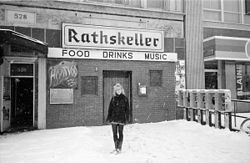
In the late 70s – early 80s the best place to see and hear rock ’n roll in Boston was basement club The Rathskeller – known as The Rat, for short. For those of you who were never in Boston back in those days, The Rat in Kenmore Square was Boston’s equivalent to New York’s CBGB’s.
Not only did The Rat have great music, it was also home to the ground floor rib joint called the Hoodoo Barbeque. The Hoodoo was relocated to The Rat after its predecessor, The Rainbow Rib Room (at the corner of Mass Ave and Newbury St), closed. Chef James Ryan had a recipe for the best ribs and barbeque sauce I’ve ever tasted and the onion rings were out of this world. They were cooked by comedy sitcom writer/producer Eddie Gorodetsky who was then a student at Emerson College and entertained his customers with his humor, cracking wise while performing his fry cook duties. Both spots had fantastic, eclectic juke boxes with records by everyone from The Clash to Tom Waits to John Coltrane.
But I digress.
The radio station I was a DJ at (WZBC) was transitioning at the time. We were quick to pick up on the US and British punk/new wave music of the day – before the big Boston commercial stations, WBCN and WCOZ. We also played the music of a lot of local bands, doing our best (with only 1000 watts) to help break them. Human Sexual Response was a favorite at ZBC. If you’ve never heard them, check out their first album, Fig. 14, on Spotify as Fig. 15. Or better yet, try to find a live performance on YouTube. They were really performance artists, so the visuals were as important as the music.
The song I’ve chosen for today’s SotW is by La Peste – one of the local scene’s most notorious punk rock bands that appeared frequently at The Rat.
“Better off Dead” is also a straight ahead punk rock record – three in-your-face chords and angry, abrasive lyrics about a daughter having under aged sex that the parents can’t do anything about.
The band was a trio fronted by Peter Dayton. Their recorded output was very slight but “Better off Dead” alone is good enough to keep their memory alive. Dayton is now a fine artist based in Long Island.
This is just one example of the vibrant local rock scene in late 70s Boston.
Today’s SotW is “Mother Earth” from the band of the same name, a group led by Tracy Nelson. The song was written by country blues artist Memphis Slim and was included on Mother Earth’s debut album Living with the Animals from 1968.
Nelson was a pretty good blues singer and piano player that often drew comparisons to Janis Joplin – partly because she moved her band’s home base to San Francisco in the late 60s and partly because her repertoire leaned toward the blues and R&B favored by Joplin. I don’t think they sound much alike even if the pained shriek Nelson lets out on the word “go” on the last line of “Mother Earth” (“You got to GO back to Mother Earth”) does remind me of Janis’ scream in her classic “Piece of My Heart.” It’s beautiful.
Another “connection” to Joplin is through Powell St. John who wrote several originals for the album and, in the early 60’s, was in a Texas band with a young Joplin called the Waller Creek Boys.
But I must admit, the real reason I’ve selected “Mother Earth” for the SotW is because it benefits from a great performance by blues guitar master Mike Bloomfield who was originally credited on the album as Makal Blumfeld, apparently due to contractual obligations.
Bloomfield grew up in Chicago and knew from a very early age that he wanted to be a blues guitarist (much to the chagrin of his wealthy parents). He studied the seminal recordings and went a step further, befriending some of the idiom’s most important masters and picking their brains to learn the techniques they devised.
Just listen to the licks and solos he played on “Mother Earth” and you can tell this guy really understood the blues including its vices — drugs and alcohol. It has often been rumored that Bloomfield recorded his parts on Living with the Animals lying on his back, too drugged out to sit up or stand. Unfortunately his excesses led to an early death by overdose at the age of 37.
But I shouldn’t sell the album too short. It really is a pretty decent album aside from Bloomfield’s contributions. Other quality musicians were involved including his colleagues from the Butterfield Blues Band, keyboardists Barry Goldberg and Mark Naftalin.
I’m long overdue for a SotW featuring new music, so I’ll fix that today with a song by the band Temples.
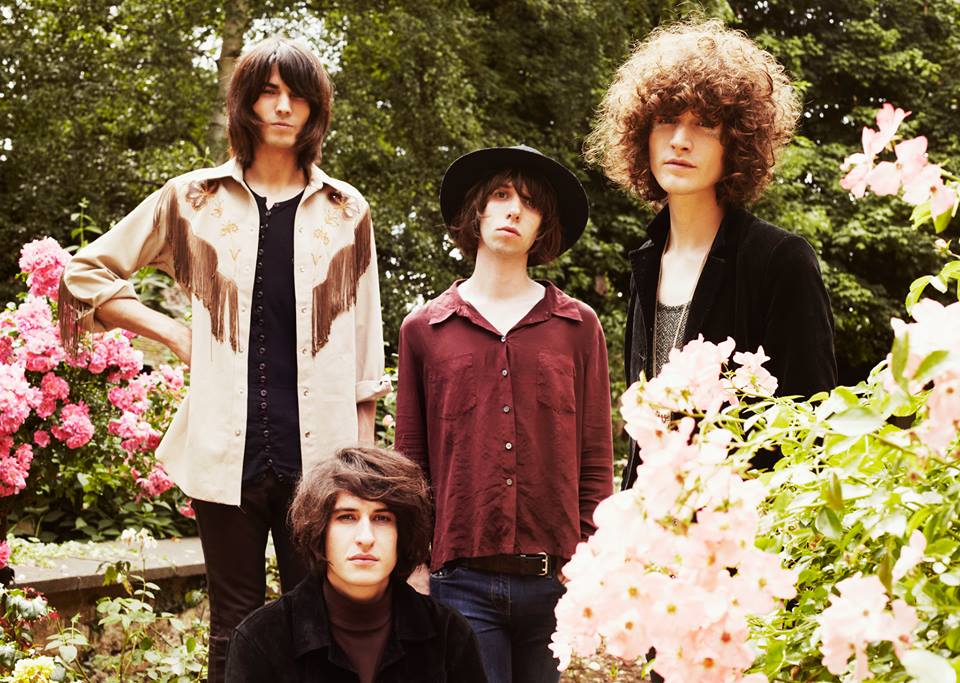
Temples is a new psychedelic 4 piece band from the UK that treads much of the same territory as Tame Impala. But where TI takes 60s psych influences and gives them a very modern face lift, Temples seems happy just to inhabit the sounds of the past. They even record with analog equipment, including reel-to-reel tape deck and effects pedals, and classic Rickenbacker 12 string guitars.
Their first single, “Shelter Song”, was released in 2013 but their debut album, Sun Structures, was just released in February.
You can hear the territory that “Shelter Song” stakes out from its first psilocybin chords. The music draws comparisons to so many icons of Nuggets era 60s psych – 13th Floor Elevators, Strawberry Alarm Clock, Byrds, Donovan, Love, Syd period Pink Floyd – that it’s senseless to try to name them all. I even hear a little Marc Bolan/T Rex glam influence too. (But I may be influenced by lead sing/guitarist James Bagshaw’s curly head of hair with that assessment.)
When Bagshaw sings the hippy dippy lyrics, his vocals are somewhat reminiscent of Robert Plant.
One night
You came on over to me
Late night
We shared a drink or three
Night night
I read a proverb to you
That night
She left a room with a view
Take all the time
Time that you want to
Make up your mind
Mind how you go
Take me in time
Time to the music
Take me away to the twilight zone
That the band has an ear for a decent pop melody is what makes their album so pleasurable. If you’re up for a paisley filled, musical nostalgia trip, Temples’ Sun Structures will take you there.
Back in the day before CDs, downloads and streaming, people bought their music on vinyl albums from record stores. The 12” album covers often had extraordinary artwork but also were large enough to publish vast amounts of information – liner notes. They included biographical info, lyrics and production credits. I would occasionally be induced to give a record a listen because I read the liner notes and thought the instrumentation was interesting or found some familiar names in the musician credits.
That was the scenario that first led me to listen to singer/songwriter Dirk Hamilton’s debut album, You Can Sing On the Left or Bark On the Right (1976). The album was on ABC Records and was produced by Dan Katz who also produced Steely Dan (one of my favorite bands) on the same label. In fact Katz brought in a slew of the session musicians — Elliott Randall, Jeff Porcaro, Victor Feldman, Larry Carlton — that played on the Steely Dan albums to work on Hamilton’s record. Instinct told me this album would be good.
Well, I wasn’t disappointed but it wasn’t because of the crack musicians. It was Hamilton’s terrific songwriting that won me over. He writes with wit and humor, and has a keen eye for detail. His lyrics use clever wordplay and rhymes.
After two records for ABC, he moved on to Elektra/Asylum where he also made a couple of albums. The first for E/A was titled Meet Me At The Crux (1978) and received excellent critical notices. In 1990, Steve Pond of Rolling Stone included it on his list of “glorious one-shots and overlooked gems” of the 70s.
Here’s the cut that Hamilton refers to as his “least unknown song,” from Crux.
I liked these records so much that in the summer of 1978 I used my affiliation with WZBC (Boston College’s radio station) to arrange an interview with Hamilton before his gig at the Last Chance Saloon in Poughkeepsie, NY. (Before the interview I was having dinner with my girlfriend at a nice restaurant. I hurried through it fearing that I was going to be late for the interview. She accused me of caring more about the interview than being with her. At that moment I did.)
Fast forward to the present.
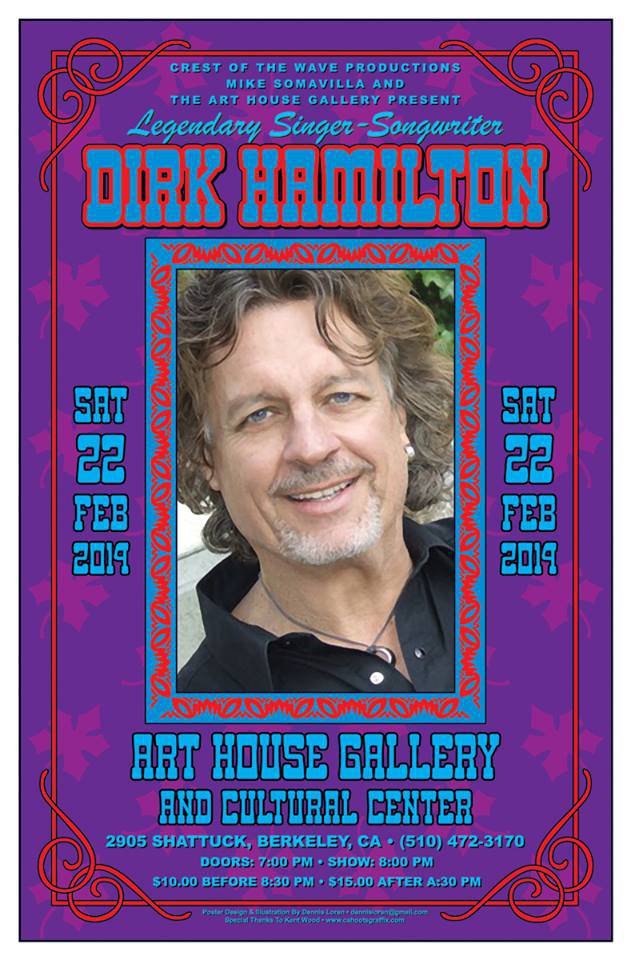
I was reading my Facebook news feed recently and what popped up? A notice that Dirk Hamilton would be performing at a funky little art gallery in Berkeley called the Art House. How this ended up on my feed I’ll never know, but I took it as a sign that I should check it out. My wife and I arrived early and were the first ones in the door other than the guy that runs the place – and Hamilton. In this intimate setting I was able to have a nice chat with him.
He told me that he dropped out of the music business for a few years back in the 80s, but quickly returned. He was born in Indiana, grew up in California and now lives in Texas where he’s still writing, recording and performing. He has a strong fan base in Italy and spends a couple of months doing concerts there every summer.
Sometimes the music business just isn’t fair. If it were, you all would already know about Hamilton and have some of his music in your collection. It’s not too late.
I recently read a blog post by music industry insider Bob Lefsetz (The Lefsetz Letter) about the new Rosanne Cash album, The River & The Thread. (He liked it.) He mentioned that the songs were co-written with her husband, John Leventhal, and went on to say that Leventhal “worked his magic most famously on Shawn Colvin’s debut, still my favorite album of the nineties, even though it was released at the tail end of 1989.”
That comment was enough to inspire me to blow the dust off a SotW essay I started years ago on Colvin’s “Shotgun Down the Avalanche” – a song off said debut Steady On that Leventhal produced and co-wrote with Colvin.
This is a lovely song with the “avalanche” serving as a metaphor for the fragility of a faltering relationship. (Stevie Nicks conjured up a similar image with her classic “Landslide.”) In fact, it’s about her relationship with Leventhal!
I love you so much and it’s so bizarre
A mystery that goes on and on and on
This is the best thing and the very most hard
And we don’t get along
After countless appeals
We keep spinning our wheels
On this mountain of new fallen snow
So I let go the catch and we are over the edge
You have left me nowhere to go
The song is beautifully arranged and performed by Colvin and Leventhal. Colvin has described getting the sound she wanted by tuning “the low E string down to D so when the verses and chorus hit the major V, a D chord, the bass would ring out.”
Steady On contains many other fine songs that had the benefit of some terrific supporting musicians including Bruce Hornsby (piano), Rick Marotta (drums), Soozie Tyrell (fiddle player now with Springsteen’s E Street Band) and Suzanne Vega (background vocals).
Over the Christmas holiday I visited my cousins in FL and they turned me on to a magazine article and DVD they had recently discovered about Dr Hook and the Medicine Show. Yes, you remember the group that had a few hits in the early 70s with Shel Silverstein penned songs, most notably “Sylvia’s Mother” and “On the Cover of the Rolling Stone.”
Well, it all started with this long form article, “We Never Have to Be Alone”, by Will Sheff that describes (in lengthy detail) a performance by Dr Hook that was taped by a German TV station in 1974. (Besides being a fine writer, Sheff is also a member of the Alt Country band Okkervil River.) Sheff makes a passionate argument that Dr. Hook and the Medicine Show, Live 1974 is the best concert film ever recorded. Ever!
My cousins had a copy of the DVD I was able to view it before reading the article. I have to admit, it is something to behold. What you see is a band that clearly has the talent to put on a great performance, but a whole lot happens in the brief 9 song, 45 minute show. Songs start and stop, guitars go out of tune, band members get pissed off at one another, and one guy even pukes on camera. But amidst all this mayhem is a performance by a band that has self-deprecating charm, wit and, at least for certain moments, flashes of brilliance. They play like they’ve got nothing to lose and it is a delight to watch.
The Sheff article has a few YouTube clips from the TV show embedded into it. Here’s one of them:
But you have to read the Sheff article (all of it) and try to get your hands on a copy of the DVD so you can view the whole thing at once. You will not be disappointed.
This weekend marks two very important anniversaries for me. It is the 50th anniversary of the Beatles arrival in the US and their “where were you when…” performance on the Ed Sullivan Show. It is also the 6th anniversary of the SotW – originally inspired by the Beatles anniversary. (The very first SotW was the Ed Sullivan recording of “All My Loving.”)
In honor of my affection for all things Beatles, I’ve decided to celebrate these anniversaries by tackling a project that has been on my “to do” list for quite some time. I’m going to lay out the famous story of the recording of “Strawberry Fields Forever” complete with audio. So buckle up!
The story begins here in San Francisco, where on August 29, 1966 the Beatles played their last concert at Candlestick Park. Freed from touring, the band members had the time to pursue other (solo) projects. John went off to Spain to shoot the movie How I Won the War, with Richard Lester who also directed both A Hard Day’s Night and Help!. It was on location in Spain that John wrote and first demoed SFF under the working title “It’s Not Too Bad.”
On Thursday, November 24th, the band assembled at Abbey Road Studios to start their next recording session. In his fine memoir, Here, There and Everywhere, Beatles’/Abbey Road engineer Geoff Emerick describes how the session started.
Down in the studio, George Martin was perched, as usual, on his high stool, positioned in the midst of the four Beatles; he liked being looked up to, so he never sat in a normal chair during routining. John was standing directly in front of him, playing an acoustic guitar and singing softly. Because he wasn’t close to the microphones we had arranged around the room, I had to push the faders up quite high to hear him…
When he finished, there was a moment of stunned silence, broken by Paul, who in a quiet, respectful tone said simply, “That is absolutely brilliant.”
It must have sounded something like this.
This demo, released on The Beatles Anthology 2, was recorded at John’s home when he returned from Spain, sometime between November 7th and the November 24th recording session. Of note is that the demo version of the song is missing the famous intro and instead begins with the “no one I think is in my tree” verse (that will ultimately be the 2nd verse in the official release).
Immediately after hearing John’s demo, the boys got down to work. They spent the next several hours “routining” – figuring out who would play which instruments and which parts. They settled on John playing rhythm guitar, Paul played the band’s newest toy, the Mellotron, George was experimenting with slide guitar and Ringo manned the drums, but placed towels on the drum heads to give them the muffled sound he was after.
They laid down one take that night.
Take 1 is generally unremarkable – the Beatles were just trying to get the feel of the song on tape – but it did result in a couple of advancements. John had come up with the verse that would end up as the first verse – “living is easy with eyes closed” – and near the end, Paul came up with the Mellotron part that ultimately became the intro.
On the evening of Monday, November 28th, the boys were back at Abbey Road to continue working on SFF. Over a session that lasted about 7 hours, they laid down Takes 2-4.
2 and 4 were full rhythm tracks (3 was a false start with John scolding Paul for playing too loud) with more guitars, bass and maracas overdubbed onto the basic tracks. They deemed 4 as “best”, so John added a vocal track. By now, the song structure had evolved to include the intro followed by the chorus to start, but still had the first verse immediately followed by the second without another chorus in between.
On the afternoon of Tuesday, November 29th, work on SFF progressed further. Two more Takes, 5-6, were recorded.
Take 5 was a false start, but Take 6 was completed. Take 6 was then “reduced” to Take 7 with another Lennon vocal overdub.
This recording is the complete Take 7 with the drum edit piece from Take 26 tacked on. More on that later. Take 7 also added ADT (automatic double tracking) to John’s vocal. This mix was deemed the new “best” and sat idle until the band took up work on SFF again over a week later.
During this break John had been listening to the acetate of Take 7 and wasn’t fully satisfied with it. He told producer George Martin he wanted to take another run at it and suggested bringing in some outside musicians. Lennon and Martin worked together to create a score for trumpets and cellos. But before they could be overdubbed, the band would have to record new rhythm tracks.
On Thursday, December 8th the work began. Mark Lewisohn’s exhaustive book, The Beatles Recording Sessions, summarizes the session this way:
By the end of the session 15 more takes had been recorded, numbered nine to 24, all of them rhythm only (i.e., no vocals). But although nine of those 15 were complete (there was, for some reason, no take numbered 19, nor was there an 8), it was two of the incomplete versions – takes 15 and 24 – which were chosen to take the song into the next stage. Before the end of this long night George Martin and Geoff Emerick edited together the first three-quarters of take 15 with the last quarter of take 24. An attempt to mixdown the two four-track edits into take 25 was started but then aborted for the night, to be continued the next day.
The work was completed on Friday, December 9th.
On Thursday, December 15th four trumpets and three cellos were brought in to overdub the score onto the rhythm track – Take 26. Over this, John recorded a vocal that sounds manic compared to his original demo. This is where John utters the non sequitur “cranberry sauce” (twice) – not “I buried Paul” as the “Paul is dead” conspiracy theorists claimed.
Of interest is the much faster tempo (and different key), George’s addition of a swordmandel (an Indian instrument) part, and backward taped cymbals.
Finally, we come to the famous edits. On Thursday, December 22nd, Lennon told Martin that he liked both versions of SFF (Takes 7 and 26). He wanted to join the beginning of Take 7 to the ending of Take 26. When Martin explained that they were recorded in different keys and tempos, John said “Well, can you fix that?”
Again, from Lewisohn’s book:
George and Geoff carefully studied the two versions and realized that if they speeded up the remix of the first version (take seven) and then slowed down the remix of the second (take 26) they might match. They were originally a semitone different. “With the grace of God, and a bit of luck we did it,” says Martin. All that was left now was to edit the two pieces together and the song – almost a full month after it was started – was finally finished. “We gradually decreased the pitch of the first version at the join to make them weld together,” says Geoff Emerick.
The final, official release begins with the intro, chorus and first verse from Take 7. Then another chorus from Take 7 was edited in to bridge to verse 2 which is where Take 26 begins. This was necessary because on Take 7, verse 1 and 2 were consecutive, without a chorus in between. The next verse (2), chorus, verse (3), chorus, and coda are all from Take 26, making the final released version of the song a musical palindrome.
There was another “edit” during the coda at the end. Ringo was having trouble keeping up the intensity of his drumming during the coda. There was one short lapse, but the section after it was very good too. The solution? The false ending fade out, then fade back in.
Did anyone notice that it was Paul Williams that gave the acceptance speech for Daft Punk when the helmeted duo won the Grammy for Album of the Year? Williams, whose earlier career was derailed from alcohol abuse, hit the bull’s-eye with his comment “Back when I was drinking, I would imagine things that weren’t there and I’d get frightened. Then I got sober and two robots called and asked me to make an album.”
We oldsters all remember who Paul Williams is. But for the benefit of those of you under 50 I’ll let you in on his career highlights.
Williams was a very successful song writer in the 70s. His greatest success came with the two big hits he composed for the Carpenters – “We’ve Only Just Begun” and “Rainy Days and Mondays” (co-written with his partner Roger Nichols). He had another major triumph with “Evergreen,” a #1 hit from the Barbra Streisand movie A Star is Born which won him a Grammy. He also penned songs for Three Dog Night (“Old Fashioned Love Song”) and others. David Bowie recorded one of his songs (“Fill Your Heart”) on the album Hunky Dory. Williams also wrote the theme song for The Love Boat TV show and Kermit the Frog’s “Rainbow Connection” for The Muppet Movie.
But few who recall his background know that earlier Williams recorded with a pop/psych band called The Holy Mackerel. I have a (white label promo) copy of the 1968 album and at least one side isn’t half bad.
The SotW is “Scorpio Red.”
“Scorpio Red” is an astrology themed, cautionary tale about a “red headed lady” that “will not be tamed.” It contains all of the trappings of late 60s psych/pop rock – Eastern influenced chords, ringing guitars, reverb and group harmony.
Another song on the album worth hearing (though not written by Williams) is “Wildflowers.”
This could be the East/West hybrid sound George Harrison was shooting for on “Within You Without You.” Or maybe not.
Back in 1998, Mercury Rev, a band from upstate New York was about to record their fourth album. Their first three had received some critical acclaim, but virtually no commercial success at home in the U.S.
The band fell into drug and alcohol abuse, sold most of their instruments and could see their demise rapidly approaching. With that as the backdrop, the band members — essentially Jonathan Donahue (vocals, guitars) and “Grasshopper” (guitars, clarinet) — assumed the new album, Deserter’s Songs, would be their last. But in Deserter’s Songs the band delivered a gem. It garnered high praise in the UK where it was voted Album of the Year by both NME and Mojo. But the album has still been heard by few here in the U.S.
Deserter’s Songs is a very quirky album of music. Less reliant on guitars, the band used keyboards (piano and mellotron), flugelhorns and even a bowed saw. They sound a bit like the Flaming Lips (especially the thin vocals) or My Morning Jacket, but with more dreamy orchestration.
The SotW is “Hudson Line.”
The tune is about getting out of New York City on the Hudson Line train up to the Catskills, where the album was recorded, to “get back to the land and set my soul free.” In fact, Mercury Rev was able to take advantage of their proximity to other Catskill musicians and recruited Garth Hudson (The Band) to play sax on “Hudson Line.” They also persuaded Levon Helm to play drums on “Opus 40,” another great track on the album.
Most of the cuts on Deserter’s Songs were written and sung by Donahue but Grasshopper wrote and sang “Hudson Line” so it has a slightly different feel from the rest of the album. It’s both bluesy and jazzy.
Deserter’s Songs should really be experienced from start to finish in one sitting. It is available on Spotify for your listening pleasure, so give it a try.