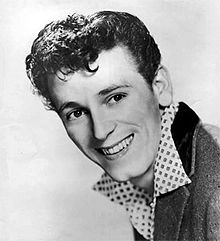
Night Music: Ian Dury & the Blockheads (with Mick Jones): “Sweet Gene Vincent”

220px-Gene_VincentAll this Wreckless Eric brouhaha is wonderful.

I so loved the punk movement. I was 25, and actually in London the week of the Stiffs Live. I remember getting on the Underground to go back to my Grandmother’s in Finchley and the punks who had been at the shows that featured Elvis Costello, Nick Lowe, Wreckless Eric, Larry Wallis, and Ian Dury and the Blockheads were on the same train.

Blue Mohawks-crap, any Mohawk on a white kid in the fall of 1977–and pierced tongues and such were still a little outrageous in the states where ELO and ABBA ruled. In fact Roxy Music, 801, The Tubes, and Queen were about as far as I could push the envelope before that fateful trip to London to visit my Granny and cousins for the first time on their turf.

What a great time I had! I remember sleeping on a boat hostile in Amsterdam with a bunch of other kids, and getting up in the morning to eat some yogurt and fruit and cheese (remember, I am in Holland) with Marshall Tucker’s “Can’t You See” blasting in the dining area.

As previously noted, that was the first time I heard the Sex Pistols:  in the tub in my Granny’s home, listening to my Aunt Hedda’s tinny transistor radio, tuned to John Peel and Top of the Pops. “Anarchy in the UK” blasted out and life would never be the same for me.

I came home hungry, riding the new wave as it broke here, a pierced (yep, did my ear the first time right after I got back), tattooed (long story, but that was actually a couple of years earlier) ever the long-hair who still fit right into his Berkeley community.

I saw as many of the English and New York bands as they arrived as I could, and being near San Francisco, that was pretty easy to do, and it was cheap, too. $3.50 or $4.00 to see three bands at a great venue.

Anyway, Gene commenting on (I’d go the) Whole Wide World, that “punk opened things up” suggesting Eric would not have happened in 1972 is so dead on. But, with the Pistols and Malcolm McLaren and the Clash, all bets were off.

Never prior to John Lydon did any band ever seem to consider that there was the radical difference between singing harmoniously and being an effective vocalist had suddenly fallen away. In fact, I remember arguing similarly with my life-long friend Karen Clayton at the time about Elvis Costello. Karen called Elvis a lousy vocalist, and I noted that maybe he was a lousy elocutionist, but he was a great lyricist and voclalist.

Enter Ian Dury, and Sex and Drugs and Rock’n’Roll, a really wonderful song: funny, self deprecating, and yet brutally honest.

But, because Sex and Drugs… seemed more like a gimmick song, it was hard to take much else by the Blockheads seriously. In fact it was hard to take Sex and Drugs… seriously.

Too bad, because they were a pretty tight band, and if you know the song Sweet Gene Vincent, you know this to be true. Not just a great song that links the same attitude of Little Richard and Chuck Berry to that of the punks, the song moves to that place using Vincent–Mr. Be-Bop-A-Lula and maybe THE original punk–as a vehicle.

This version of the song is from the The Concert for Kampuchia, and joining in the Blockheads is the Clash’s Mick Jones, by the way. And, let me tell you, we are far from done with the subject.


Lawr Michaels Hates These Songs (most of which have to do with Martin Luther King)

You may, too. I’m not here to argue that they’re great music. But I think they’re pretty spunky pop songs, and for some reason Lawr picked them out of thin air and created a pantheon of my bad taste.

But maybe you don’t know about them.

Royal Guardsmen, “Snoopy Vs. the Red Baron”

History is a deep well of ideas for stories and songs. This song borrows a rather odd story from the Peanuts comic strip to tell the story of the greatest fighter pilot if World War I, the war to end all wars, and how he was vanquished by a cartoon beagle whose best friend was named Woodstock. With harmonies and sound effects, and Snoopy of course, who at the time was big. Irresistible. As a 10 year old I don’t think I thought much about the copyright implications of using a character created by someone else in a pop song. But the writers were sued by Charles Schulz, the creator of Snoopy, and United Features Syndicate, which sold the strips to newspapers, and lost, and ended up giving up all publishing royalties to Snoopy’s creator. Ouch.

Fun fact: Co writer Dick Holler’s other big hit song was “Abraham, Martin and John,” performed by Dion. Martin Luther King fact No. 1.

Bobby Goldsboro, “Honey”

This is not rock in any shape or form. It’s Lawrence Welk crossed with some kind of kitchen sink melodrama, shaped by Jeff Koons. I like the plain spoken words, which don’t overreach while drawing grandiosely from a vocabulary of knee jerk emotion. Rain falling on kittens? Go away. The song was written by a guy named Bobby Russell, whose other hits were Little Green Apples and The Night the Lights Went Out in Georgia, two other songs Lawr probably hates.

Fun fact: Honey hit No. 1 on the Billboard charts the week Martin Luther King was murdered. Martin Luther King fact No. 2.

Strawberry Alarm Clock, “incense and Peppermints”

The Strawberry Alarm Clock are still touring and recording. This, thier first single, has some of the sound of a Door’s song, but it also has sweet backing vocals, skrunky guitar breaks, pentatonic piano backups, and a lot of other fake psychedelic effects, ending with a sweet Cowsills-like harmony. It is all going to be alright.

Fun fact: The band’s drummer worked up a jet system attached to his wrists, so it looked like his hands were on fire while he played.

After their No. 1 experience they were scheduled to go on tour with the Beach Boys and Buffalo Springfield, but many dates in the south were cancelled after Martin Luther king was killed. MLK fact No. 3.

Norman Greenbaum, “Spirit In the Sky”

I was going to write a lot about the guitars and the backup singers. Norman’s plain and straight-forward vocals, and the song’s clean melody. It’s a rhythmic stomp, a dark harbinger, and an inspiration even if you’re an unbeliever, all at once. But it’s the killer guitar sound and the gospel singers backing it up that make it work. But then I saw the video. Wow. There is that Jesus stuff, but Norman was a good Jewish boy trying to write some Gospel music, and he succeeded. Though for me it isn’t the gospel, it’s the sound, which is pretty unusual for AM radio hits.

Bob Dylan is another Jewish boy to write praise songs for the Lord. FWIW.

I’m told the song is used to introduce the Angels of Anaheim before their home games. Good choice.

And then there is Martin Luther King fact No. 4.

Zager and Evans, “In the Year 2525”

Totally catchy, but totally ridiculous. I’m embarrassed for ever having suggested this had any redeeming value. Fun fact: It was knocked off the No. 1 spot on the Billboard Hot 100 by the Stones Honkey Tonk Women.

Plus, there is no Zager and Evans and Martin Luther King connection. How can that be?

My First Date

Jean lived out near the Mall, so we decided to meet out her way. I was 14, maybe. An imbecile.

I remember a few things. Their priority will show why this was a middle school disaster.

On the bus out to the mall I heard Steppenwolf’s The Pusher.

I also heard Norman Greenbaum’s fantastic Spirit in the Sky.

My buddy Bobby’s brother suggested that if the word “tissue” came up one should say –Tissue, I hardly know you.

We were in the camera shop when Jean said tissue.

KISS Shocker: They Won’t Perform at Hall of Fame Induction

kiss socketsWe like to have fun with Kiss, who have had a long and storied career.

But now they’ve done it. Somehow these guys have turned a fast start and then years of grinding mediocrity ever afterward into something even Barry Bonds can’t claim: Membership in a Hall of Fame.

But rather than celebrate the moment, put on one of those wild HoF jams that burnish careers, a dispute between the founding members and the current members will keep Kiss offstage (and maybe even some inductees out of the Barclay Center).

Sad, really sad.

Lunch Break: De La Soul, “Talking ’bout Hey Love”

De La Soul was the best of a flowering of hip hop groups about 25 years ago who broke the hard street mold of lots of rap back then. Others I liked a lot were the Jungle Brothers and Monie Love. DLS were from the Long Island suburbs and their music, designed by another Long Islander named Prince Paul, is usually affable and often funny, sometime surreal and not all that aggressive. But it crackles and pops atop a big resounding beat, sometimes with some sharp social observation, while you sway and smile. Their tunes have the scratchy feel of an oldie, mashed up and filtered through time and polished with a modern attitude, filtered by a sense of humor even when angry.

This tune is a good one for Valentine’s Day, a love song built on a Stevie Wonder song, with some sharp spoken word to round it out. Hmmm, maybe not so good for Valentine’s Day after all.

I bring De La Soul up today because as a promotion for something new that’ve got coming up they’re giving away mp3s of all their music. That seems like a funny way to do business, but a visit to YouTube shows all their albums online already. You can sign up for the promo (you have to share an email address) at wearedelasoul.com. UPDATE: I always wondered why I couldn’t stream Three Feet High at Google Music or Mog, and it seems the answer is that because of the way the rights were cleared neither label nor band had the rights to release the music digitally. That seems about to change, as well as the band having new music coming shortly. Now you know.

Which is the best De La Soul album? People I’ve been reading today seem to favor Buhloone Mindstate, but by that time my attention had flagged a little. Both 3 Feet High and Rising and De La Soul Is Dead caught me at a really good moment, so I think it’s probably best to start at the beginning, if you’re going to wade in.

Then tread water.

Night Music Goes to the Movies: Gene Krupa & Barbara Stanwyck, “Boogie”

This month my favorite TV network, TCM, is having their annual “31 Days of Oscar” leading up to the actual awards ceremony (to which I am fairly indifferent). During that span every film TCM shows has at least been nominated for an Oscar, and most have won at least one.

TCM is a treasure trove of cinematic brilliance, with the bulk of their offerings focusing on the heyday of the studio system in the 30’s and 40’s.

One of the standards in those movies was to toss in a song. Which is why in the middle of a dark and brilliant Noir film, like The Big Sleep, we see Lauren Bacall singing at a speakeasy operated by gangster Eddie Mars (he is to this film, sort of what Jackie Treehorn was to Lebowski).

So, this morning I was working with TCM on in the background when Howard Hawks’ (who also made The Big Sleep, and my favorite Screwball Comedy, Bringing Up Baby) Ball of Fire came on.

Written by Charles Brackett and Billy Wilder, the film is a great Screwball Comedy that deconstructs Snow White and the Seven Dwarves, placing the setting in Manhattan in the early 40’s, with Stanwyck playing the moll Sugarpuss O’Shea to Gary Cooper’s English professor Bertram Potts (Cooper is one of eight sheltered eggheads working on an encyclopedia).

A few other things:

  • Every great character actor and cartoon voice from that time are among the professors, so if you watch, you will suddenly hear Fractured Fairy Tales etc. in the back of your head.
  • This is the last script that Wilder and Brackett wrote before Wilder went on to his fantastic career as a director (Stalag 17, Some Like it Hot, Sunset Boulevard, and Double Indemnity are just a few).
  • One thing that stuns me about Wilder is that English was his second language, yet his writing in our language is so sharp. And, if you watch Ball of Fire you will get an idea of just that. This movie is as funny and witty as anything ever put on the big screen.
  • One other thing I love about Wilder is the apocryphal tale of when he premiered Sunset Boulevard for a cluster of Hollywood moguls, after the film Samuel Goldwyn got up and chastised Wilder for making such a dark portrayal of the industry that made him rich and famous. What was Wilder’s response to the most powerful man in his industry, in front of their peers? “Fuck you.”

Back to the movie, as part of the set-up, Cooper/Potts takes to the streets fearing his grasp of slang is already outdated, and happens upon O’Shea at a night club (he also goes to a ball game and gets some good slang there).

O’Shea is the singer at the club, and though her singing and the song are marginal, Gene Krupa and his big band are just deadly. So is the piano player and the guy who does the sax solo. Funny too, cos playing guitar was just a minor rhythm instrument, as you can see in most films of this ilk.

Anyway, Canned Heat et al all owe their boogie chops to this great scene.

And, just for fun, after the big number, Krupa and Stanwyck reprise the song with Krupa playing matchsticks instead of drumsticks.


RIP: Philip Seymour Hoffman (1967-2014)

 Actor Philip Seymour Hoffman, the chameleon of contemporary actors, was found dead Sunday, ostensibly the victim of a self-inflicted heroin overdose.

bangsAt age 46, this is a sad loss as Hoffman was just a great talent, so able to look and act differently depending upon the role.

Hoffman did win an Oscar for his role as writer Truman Capote in the 2005 film, Capote.

But, there are basically three films Hoffmans, I really loved, all three of which had great music floating around in a direct or indirect fashion.

Boogie Nights-Hoffman played the sexually confused Scotty J, a sort of Gaffer in the world of porn film:  an insecure nerd who has somehow stumbled into the dream world of the repressed voyeur.

The Big Lebowski-This time Hoffman plays Brandt, instead of a Gaffer, he is a gopher for David Huddleston’s other Lebowski, a wonderfully restrained brown-noser. My favorite line of Hoffman’s is “Well Dude, we just don’t know.”

Almost Famous-My favorite of Hoffman’s roles, as he plays the great–and also sadly late and nihlistic–rock critic Lester Bangs. Bangs, who penned the iconic definitive rock critique book Psychotic Reactions and Carburetor Dung, died of alcohol and drug abuse, and now Hoffman has followed.

So sad.

Little Stevie Saves Paul Simon’s Life…

and other tales of apartheid and South Africa.

RIP: Pete Seeger (1919-2014)

Folk great Pete Seeger passed away today, ideally peacefully, at the age of 94.

Seeger might not be thought of as a rocker, but he represented the spirit and attitude that any serious musician–or artist, for that matter–held and spoke, unashamedly about any cause.

Seeger was a founding member of the Weavers–who recorded probably had their biggest hit in the 50’s with Goodnight Irene by Lead Belly–some of whom were blacklisted during the McCarthy era for their beliefs.

However, in the 60’s, with the emergence of Bob Dyan, Joan Baez, and Peter, Paul, and Mary, Seeger found company and even a mentor-ship as his songs If I Had a Hammer, Waist Deep in the Big Muddy, and Turn! Turn! Turn! found their way to radio play.

Seeger, who played with Woody Guthrie as well as Lead Belly (with whom he co-wrote So Long, It’s Been Good to Know You along with fellow activist and musician, Lee Hays) was a pioneer in roots recording, and equally important, the Civil Rights Movement that grabbed hold in the 60’s, and is really still going on.

Seeger was a great gentleman by all accounts, and a man dedicated to humanity and equality and freedom for all human beings: something I like to think all artists, and especially rockers, strive for.

But, in thinking about Seeger, I could not help but think of the clip of him in Martin Scorsese’s fabulous American Masters documentary about Bob Dylan, No Direction Home.

Seeger is so sweet and perplexed and definite about wanting the cables to the electric guitars of Mike Bloomfield and Dylan at the Newport Folk Festival, in 1965, that it is funny to think how we all as human beings have our limits and adjustments.

For, Seeger was indeed a progressive politically. And, as a guy who quit the Weavers because they had signed an agreement to perform a cigarette jingle, he was certainly principled. But, I guess some progress, like cranked up Mike Bloomfield blues licks were hard to take for a middle-aged banjo player.

The world was a better place with, and because of Pete Seeger. And, it is sadder with him gone.

I did try to find the clip from No Direction Home, but couldn’t (although I highly recommend the movie and soundtrack) but, I did find this lovely clip of Seeger performing Dylan’s Forever Young.

And, well, remember, attitude does not have to be in-your-face Ted Nugent. A quiet message is always the most powerful, and Seeger was the purveyor of just that.


Oldies: Screaming Lord Sutch and the Savages, “Jack the Ripper”

shawncrahan-grammys2014
A lovely family portrait at the Grammys, with Slipknot’s Shawn Crahan and his lovely family.

kiss-halloween
Then there is young Kiss, well before it all got a little tired.

But the painted face shtick was fresh in 1964.