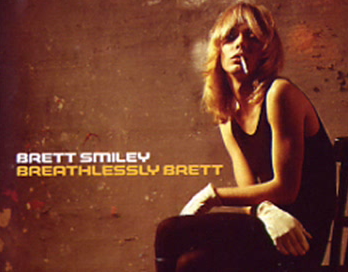
There’s a lot of dying going on, but this afternoon I read a story in yesterday’s NY Times about a singer songwriter I’d not heard of. Brett Smiley had the aim back in the day to be a similarly big star in the glam rock world as David Bowie, and coincidentally died two days before Bowie, at age 60.
Josh Max became friendly with Smiley in Central Park in the 80s. They played guitars together, critiqued each others songs, but it wasn’t until Max looked Smiley up on the internet after his death that he learned the whole story, which involves Andrew Loog Oldham, a scrapped 1974 album that wasn’t released until 30 years later, oh, and the drugs. But Max does a convincing job introducing Smiley as a genuine nice guy whose story is certainly sad but maybe not exactly tragic.
Loog Oldham recorded that original album, but after the release of the first single (Space Age b/w Va-va-va Voom), he pulled the record. It wasn’t put out until 2004. The reason?
Max writes: “I just refused to let them release the album,” Mr. Oldham said. “I knew it would be a disaster, and we’d already had one — the 45 r.p.m. release of ‘Space Ace,’ ” a song from the record.
Wow, things are getting tight for the rockers of our youth, for now Eagles guitarist Glenn Frey has passed away today at the age of 67, apparently from multiple illnesses.
Again, I was slow to come to the Eagles although I remember an ex-girlfriend, Cindy Graham, playing Already Gone for me the first time in 1976 saying how much it was my kind of song.
Cindy was right and that started my interest in the band that did indeed grow to some pretty good respect.
Frey was core to the band along with Don Henley, Bernie Leadon, Randy Meissner, and later Timothy B. Schmidt (a great bass player) along with the great Joe Walsh. Say what you will: these guys could play.
I am sure there will be more words to come, so I will keep this short and just give you the song with thoughts of Glenn as he changes planes.
I hadn’t really planned to post about David Bowie today. All week there have been media articles, radio tributes, and playlists to honor his passing. Sirius/XM even turned The Loft into an all Bowie station for a limited time. What more is there for me to add to the conversation?
But a very good friend of mine sent me an email saying he was looking forward to my take on the Bowie legacy so I decided to take a stab at it after all. My slant is to illuminate the various facets of Bowie as a performer, interpreter, writer and collaborator.
I’ll start by simply offering my all-time favorite Bowie song, “Heroes.”
“Heroes” was released as a single but never really achieved meaningful chart success. It was a well-known album cut but wasn’t among his most commercial releases. So I was surprised when I notice that it is the 3rd top Bowie song listened to on Spotify (with over 25 million streams, behind only “Space Oddity” and “Life on Mars”).
I’ve always dug the way it starts off with such power but continues to build and build, even when you think it’s no longer possible.
Next let’s listen to Bowie covering another artist – Bruce Springsteen’s “It’s Hard to Be a Saint in the City.”
Bowie was an early proponent of Springsteen, having recorded two songs (“It’s Hard to Be A Saint…” and “Growin’ Up”) from The Boss’ first album Greetings From Asbury Park, N.J.
There are scores of great covers of Bowie songs by others. Take a listen to “Let’s Dance” by M Ward.
This melancholy version of Bowie’s exhilarating club hit underscores the simple beauty of the song.
Finally, Bowie was always generously shared his talent with other artists, from Bing Crosby (“Little Drummer Boy”) to Mick Jagger (“Dancing in the Street”) to Queen (“Under Pressure”). My pick for a cool collaboration is his effort with Arcade Fire on their “Wake Up.”
You can just get a sliver of Bernie, at Theo Epstein’s Hot Stove Cool Music charity event in Boston yesterday. Reports were they played a Kiss song, but I don’t think this is it. Other reports were that Kevin Youkilis play a mean tambourine.
I don’t know what this links to. I hope it gets you to an MTV interview with Bowie about Black artists on the channel. He does a great job of being firm and being gracious. (It looks like you have to copy the link and paste it into your browser. It is worth it.)
This was a big week for deaths. David Bowie, of course, but also baseball great Monte Irvin, terrific actor Alan Rickman, and scroogie throwing Luis Arroyo, whose best season was the year I totally fell in love with baseball. Which is, I think, why I said, oh no, when he showed up in the obits.
Giorgio Gomelsky was in those same pages today, and you can read William Grimes’ excellent obit for him here. I bring nothing to this except the desire to highlight a few facts and link to a few of the many odd bands that Gomelsky worked with over the years.
The biggest ones were the Rolling Stones. He gave them their first paying gig at the Crawdaddy Club. They each took home almost a buck, which is better than many bands today. Jagger’s School of Economics savvy kicks in for sure.
But he lost the Stones to the droogie Andrew Loog Oldham, so he signed up the Yardbirds. Well done!
One of the cool details from Giorgio’s life is that he was born on a boat going from Odessa, Ukraine, to Genoa, Italy.
Google maps does not offer a boat option for transportation, but this is not an easy trip.
The most surprising fact in Giorgio’s obit is that he gave Eric Clapton the Slowhand nickname.
I had always assumed that it was because Clapton is so dexterous that he made fast playing look slow. That’s what I thought. But no!
Here’s the real story, from Grimes’ obit:
“Mr. Gomelsky also gave Eric Clapton, the group’s original lead guitarist, his nickname. Mr. Clapton told The Daily Mail in 2013: “I used light-gauge strings, with a very thin first string, which made it easier to bend the notes, and it was not uncommon, during frenetic bits of playing, for me to break at least one string, While I was changing my strings, the audience would often break into a slow hand clap, inspiring Giorgio to dream up the nickname of Slowhand Clapton.””
Incredible, no? To me, yes.
But Giorgio went on to better things. I’m sorry that I had no idea about his Tonka Wonka Mondays at Tramps. Brave mix ups of rock and jazz musicians willing to jam should have been a natural for me, but I missed it. This was the bar/club that gave Buster Poindexter a regular showcase, and where I got to see Big Joe Turner live, huger in some ways than seeing the Stones in ’73 at the Garden.
But I digress. The cool thing about Gomelsky, at least according to his own words in his obit, is that he had no eye on a music career, but merely wanted to make things right. I like that impulse.
Here’s a few clips from folks he worked with. But read the obit. I wish more lives like his were memorialized.
This clip is really great. I’m posting more Magma soon. Wow.
Fred Frith’s band, Henry Cow, covers a Phil Ochs song.
Mali was the home of the great blues guitarist, Ali Farka Toure, who channelled John Lee Hooker from across the water and brought him back home to the deserts near Timbuktu.
Songhoy Blues were formed by north-Mali musicians exiled to Bamako in the south by jihadists who banned western music in their appropriated shariahland up north. There’s a movie out about the exile of the musicians of Mali, called They Will Have To Kill Us First, which features Songhoy Blues.
I started watching this tune because of the colorful and appealing video, but I’m a sucker for Africans from all over the continent playing electric guitars, so I share this guitar music here.
Their first single was produced by one of the guys from the Yeah Yeah Yeahs, and the video seems to have been recorded in a Soho loft in New York City. This is a rockier tune.
I went with some friends to see Pierre Kwenders at a small room off Broadway called the David Rubenstein Atrium last night. They regularly program free shows in the atrium, and this was the first I’ve gone to.
Kwenders is from Kinshasa, Congo, and now lives in Montreal. His band, three young Quebecois, play guitar and keyboards, various drums, and dj. It’s this last that was a little problematic. Being able to fire samples of strings and horns and chants distorts the small band vibe. Not that this world music wasn’t lush and gorgeous, it was, but when all that recording came to fore things started to sound more like a Peter Gabriel record than a four-piece band on a small stage playing for a couple hundred people. Live became qualified.
The best songs were popping and angular, with a little space between beats. Kwenders is a crooked and crafty dancer, a strong vocal presence in three languages (French, English and, maybe, Lingala–the predominant Kinshasa language), and a charming host. This was his first show ever in the US, and he got the decidedly mixed crowd (all ages, all colors, many nationalities) on their feet and singing and clapping along. The song that got us to the show was Mardi Gras, on record a Francophone hip hop hipster melange, but lacking the rap parts live seemed more a cajun lament.
Another good one was a raucous reggea-ish tribute to the Rumble in the Jungle called Ali Bomaye! This is a much sparer version than what the band played last night, but in a way the spareness is a tonic, an open window into Kwender’s lovely voice and lyrical songwriting.
More than 13M views have accrued to this clip, so it is hardly rare. But it’s new to me. And it’s fantastic. (What is also new to me is that bands other than the Beatles made videos (or whatever) this way in the 60s. Very cool. h/t to Angela.


 There’s a lot of dying going on, but this afternoon I read a story in yesterday’s NY Times about a singer songwriter I’d not heard of. Brett Smiley had the aim back in the day to be a similarly big star in the glam rock world as David Bowie, and coincidentally died two days before Bowie, at age 60.


